
In 2014, India solar capacity stood at 2.82 GW. By 31 October 2026 it had about 175 GW, roughly 62 times as much. Solar is now the largest block of India’s renewable energy. A government backgrounder published on 17 November breaks down how that happened, and it is a useful case study in how policy, markets and households can move together.
India solar capacity: the headline numbers
- Utility-scale (large) projects: 133 GW, including the solar share of hybrid plants.
- Grid-connected rooftop: 34.97 GW. The rest is off-grid.
- FY 2025-26 additions: 44.61 GW, almost double the 23.83 GW of the previous year; another 24.29 GW had already been added in FY 2026-27 at the time of writing.
- India added about 37 GW in calendar 2025, ahead of the United States’ 34 GW, making it the second-largest solar growth market after China.
- Solar module manufacturing capacity: from 2.3 GW in 2014 to about 172 GW in March 2026 and 192 GW by June 2026.
- Total non-fossil capacity: 308.03 GW as of 30 September 2026.
The five pillars
1. A vision. At COP26 in Glasgow, India announced the Panchamrit goals: 500 GW of non-fossil capacity by 2030 and net zero by 2070. Mission LiFE adds the citizen side, nudging sustainable consumption.
2. Demand. The National Solar Mission (2010) set early targets. Renewable Purchase Obligations require utilities to buy a set share of power from renewable sources; the trajectory is notified to 2029-30, and the 2026-27 target is 35.95 per cent. Beyond utilities, two schemes build demand directly from households and farmers (below).
3. Cheaper by auction. Reverse auctions, where developers compete to offer the lowest tariff, took solar prices from around Rs 18 a unit in 2010 to a record Rs 1.99 a unit in 2020 in a Gujarat tender. By 2025, the levelised cost of utility-scale solar in India was USD 35 per MWh against a global average of USD 44.
4. Infrastructure. The Solar Parks Scheme provides ready land and shared infrastructure. As of October 2026, more than 50 solar parks with a combined sanctioned capacity of 39,461 MW have been approved, led by Gujarat (12,150 MW) and Rajasthan (10,726 MW). Bhadla in Rajasthan, built in phases by 2020 on about 5,700 hectares of arid land, has 2,245 MW. The Green Energy Corridor has enabled evacuation of about 24,568 MW of renewable power through February 2026 (see also Green Energy Corridor Phase III).
5. Manufacturing and quality. A production-linked incentive scheme for high-efficiency modules (Rs 4,500 crore, expanded by Rs 19,500 crore) had attracted around Rs 35,000 crore of investment by October 2024. ALMM, the approved list of models and manufacturers, sets quality criteria and nudges buyers toward domestic makers (see our report on ALMM and rooftop net metering).
Solar for homes and farms

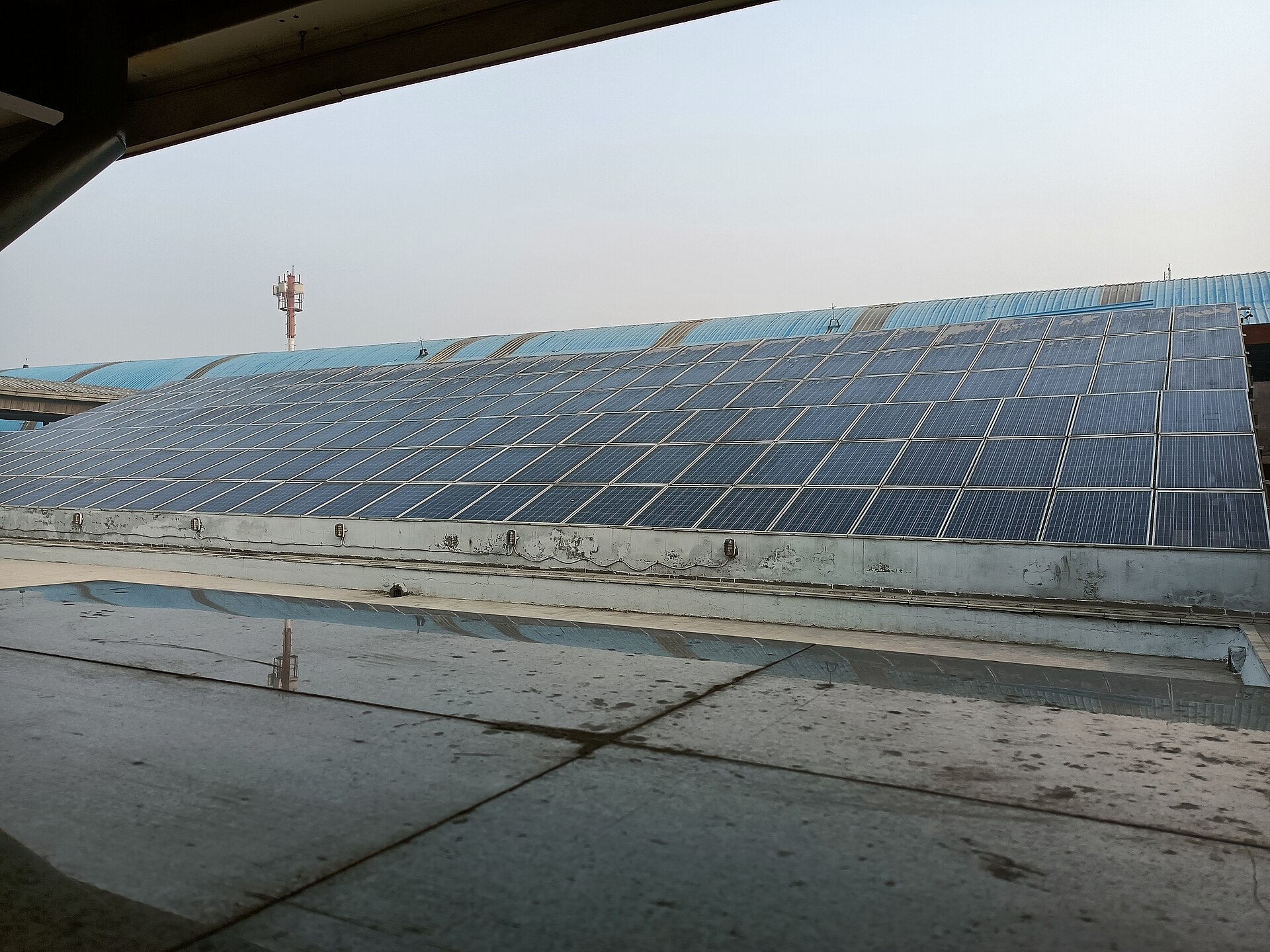
PM Surya Ghar: Muft Bijli Yojana (launched 13 February 2024, outlay Rs 75,021 crore) is billed as the world’s largest domestic rooftop programme. About 65 lakh households were solarised as of November 2026 and over 21 lakh report zero electricity bills. The release also gives the story of a Gwalior household whose monthly bill, once above Rs 10,000, is now almost negligible. More in our PM Surya Ghar coverage.
PM-KUSUM (launched 2019, central support Rs 34,422 crore) targets about 34,800 MW for farmers: standalone solar pumps, solarised grid pumps and small plants on farmland. As of 30 September 2026, nearly 11.91 lakh off-grid pumps were installed, over 17.18 lakh pumps were covered by feeder solarisation and about 2,426 MW was commissioned on farmers’ land. In FY 2025-26, distributed solar delivered 16.3 GW, or 36 per cent of all solar additions (7.6 GW from KUSUM and 8.7 GW from rooftops). See agrivoltaics and the next phase of PM-KUSUM.
Floating solar
PM Surya Sarovar Yojana, approved 31 July 2026 with a Rs 5,070 crore outlay, targets 5,000 MW of floating solar paired with at least two hours of storage (10,000 MWh), built over FY 2026-27 to 2030-31. The National Institute of Solar Energy estimates floating solar potential of about 102 GWp on India’s reservoirs and inland water bodies, and the government expects about 10 million tonnes of CO2 saved a year and 16,000-17,000 jobs. Current floating capacity is about 800 MW. Using existing water bodies eases pressure on land.
Beyond India’s borders
India co-founded the International Solar Alliance with France at COP21 (2015) and proposed One Sun One World One Grid in 2018, later launched as the Green Grids Initiative with the UK at COP26. During its G20 presidency, India helped build consensus on tripling global renewable capacity by 2030.
What still needs fixing
Capacity is not the same as clean electricity delivered. Ember estimated that India lost about 2.3 TWh of solar generation between May and December 2025 to curtailment (mostly grid-security cuts), and found transmission delays left nearly 4 GW of solar facing evacuation limits in December 2025. Storage, flexible coal plants and demand-side response are needed to use the midday surge. Our explainer on pumped storage shows one answer.
The takeaway
India’s solar story is a combination of a clear target, guaranteed demand, competitive prices, shared infrastructure and local manufacturing. The next chapter is about the grid: moving the sun’s power from midday into the evening. For more, visit our sustainable energy section and our earlier piece on India’s solar growth.