
More than 80% of the water India has available goes to agriculture. And yet, of the country’s net sown area, barely half has any assured irrigation at all — the rest depends on rainfall showing up on schedule, which, as any farmer in a drought-prone district will tell you, is an increasingly unreliable bet. That gap between how much water farming consumes and how efficiently it’s actually used is exactly the problem a scheme called Per Drop More Crop (PDMC) was built to close — and a new PIB backgrounder published in August 2026 shows it’s now doing that at a scale worth paying attention to.
As of July 2026, PDMC has brought more than 115 lakh hectares (11.5 million hectares) under micro-irrigation across India, benefiting over 12.3 lakh farmers — about a fifth of them women.
What Micro-Irrigation Actually Solves
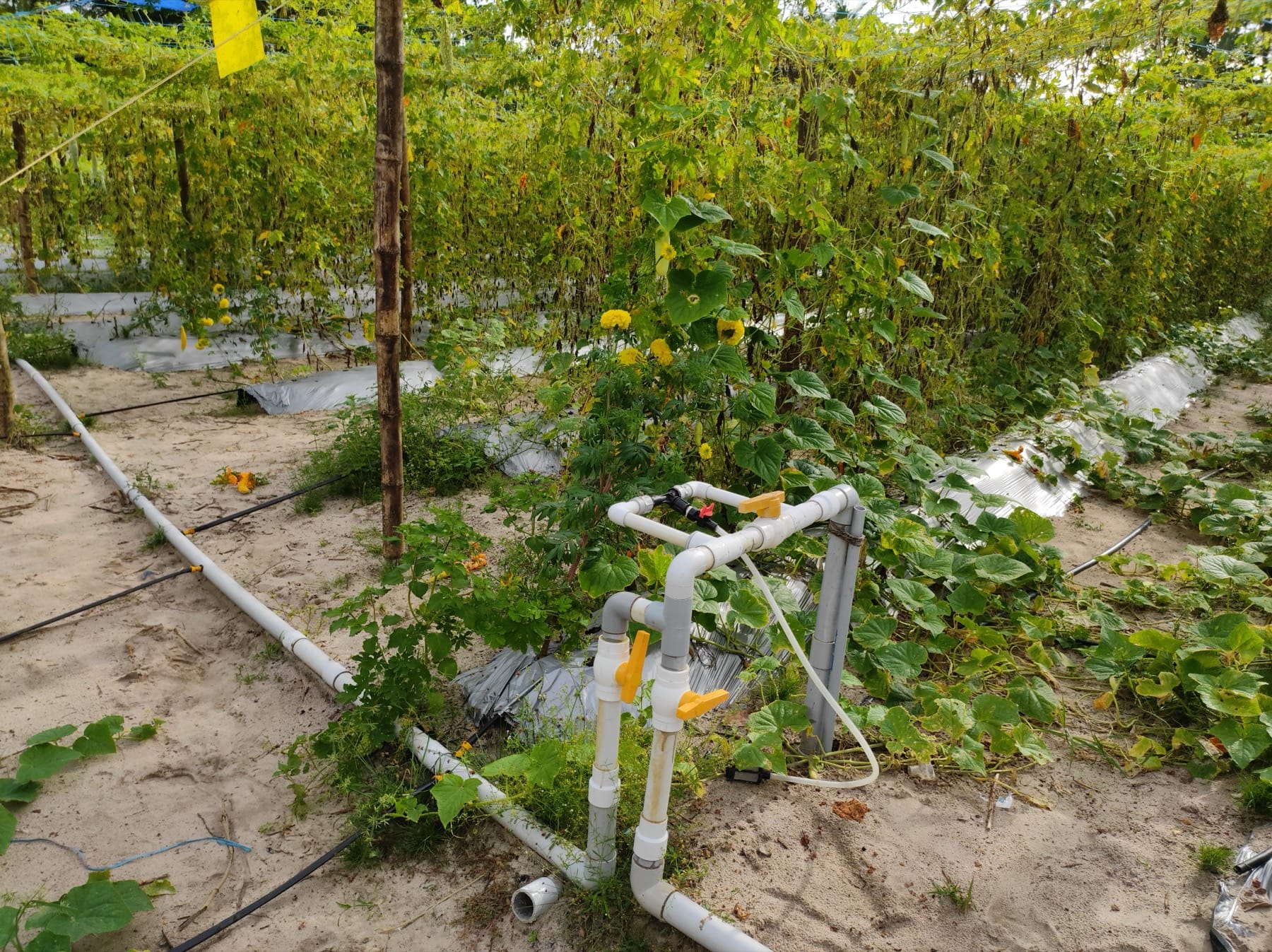
Traditional flood irrigation — flooding an entire field and letting water find its way to plant roots — is simple, but it’s also spectacularly wasteful. A large share of that water evaporates, runs off, or seeps away before it ever reaches a crop’s root zone. Micro-irrigation systems — chiefly drip irrigation, which delivers water directly to the base of each plant through a network of tubes and emitters, and sprinkler irrigation, which distributes water in a controlled spray — cut that waste dramatically by putting water only where and when a crop actually needs it.
PDMC, launched as a component of the Pradhan Mantri Krishi Sinchayee Yojana (PMKSY), subsidises the cost of installing these systems: small and marginal farmers can get up to 55% of system costs covered, other farmers up to 45%, on holdings of up to five hectares. Over the past three years, the central government has released roughly ₹8,123 crore for implementation — a substantial, sustained fiscal commitment rather than a one-off pilot budget.
The Numbers That Matter More Than the Headline
115 lakh hectares is the number that gets the headline, but the more interesting figures sit underneath it. A NITI Aayog evaluation of the scheme found farmer income gains ranging from 10% to 69%, alongside water-use-efficiency improvements of 30% to 70%, depending on the crop and region. Independent field reports elsewhere have documented yield increases in the 20–30% range for farmers who switched to micro-irrigation, alongside meaningfully lower cultivation costs — less water pumped means less electricity or diesel burned running pumps, and more precise water and fertiliser delivery (many drip systems allow “fertigation,” delivering dissolved nutrients through the same lines) means less fertiliser wasted too.
Put those together and the pitch is genuinely compelling: a farmer using less water can, in many cases, end up growing more crop and spending less to do it — the kind of efficiency gain that’s rare to find in agriculture, where trade-offs between input cost and yield are usually much harder to escape.
Why This Is a Climate Story, Not Just a Farming Story
It would be easy to file PDMC under routine agricultural policy and move on, but the water-scarcity backdrop makes this a climate-resilience story as much as a productivity one. India’s monsoon has grown more erratic in recent years — later onsets, longer dry spells within the season, and increasingly intense but shorter bursts of rainfall that run off rather than soak in. Groundwater tables in several of India’s most agriculturally intensive states have been falling for decades, driven substantially by exactly the kind of inefficient flood irrigation that micro-irrigation is designed to replace.
Every hectare converted to drip or sprinkler irrigation is, in a real sense, a small hedge against that unpredictability — a farm that needs less water to produce the same output is a farm that’s less exposed when the rains come late or run short. At the scale PDMC has now reached, that’s not a marginal effect. It’s tens of millions of tonnes of water, cumulatively, no longer being drawn from rivers, canals, and aquifers that are already under mounting pressure.
The Honest Gap
Here’s the number that keeps this from being a triumphant story: 115 lakh hectares under micro-irrigation, against roughly 140 million hectares of India’s total net sown area, means something in the range of 90%+ of Indian farmland still isn’t using these systems. The scheme has genuinely accelerated in recent years, and the subsidy structure clearly works well enough to have moved the needle — but scaling from “the leading edge of adoption” to “the norm” is a fundamentally different and much harder problem, one that runs into everything from upfront cost barriers even after subsidy, to smallholders’ access to credit, to simple lack of awareness in remoter farming districts.
That said, the trajectory matters. A scheme that has gone from a modest pilot component of PMKSY to covering 115 lakh hectares and 12.3 lakh farmers, with documented income and water-efficiency gains backed by independent NITI Aayog evaluation, has cleared the bar of “does this actually work” — the remaining question is purely one of speed and reach. For a country where farming still employs close to half the workforce and consumes the large majority of available fresh water, how fast that reach expands may end up mattering as much for water conservation in India as any single dam, canal, or urban water policy.
PDMC’s water-efficiency logic sits alongside other major government pushes on rainwater harvesting and India’s broader sustainable farming agenda — together forming the backbone of how India is trying to farm more with less water as its climate grows less predictable.
Source: Press Information Bureau, Government of India — Water-Smart Farming with Per Drop More Crop