
Pick up two packets of “organic” food in an Indian store and you may spot two different green logos — one says Jaivik Bharat, the other says India Organic (increasingly relabelled as the Unified India Organic logo). It’s a fair question: are these competing certifications, and does it matter which one you trust?
The short answer is that they are not rivals. They come from two different government bodies, serve two different purposes, and in most cases both end up on the same certified product. This guide breaks down exactly how Jaivik Bharat and India Organic relate to each other, which one actually matters for your buying decision, and why a product might legitimately carry both, one, or — with 2025’s regulatory update — a newer combined mark.
If you haven’t read our foundational explainer yet, start with Jaivik Bharat — India’s Organic Food Logo & Certification Explained for the full background on the FSSAI regulation behind these marks.
Two Logos, Two Ministries, One Underlying Standard
The confusion mostly comes down to the fact that Jaivik Bharat is not a certification body — it is a consumer-facing recognition logo. India Organic, on the other hand, is the certification mark tied directly to India’s organic production standard. Here is the distinction in plain terms:
- Jaivik Bharat is issued by the Food Safety and Standards Authority of India (FSSAI), which sits under the Ministry of Health and Family Welfare. It was introduced in December 2017 as a single, unified mark so Indian consumers could trust an “organic” label at a glance, regardless of which certification scheme backed it.
- India Organic is the certification logo of the National Programme for Organic Production (NPOP), administered by the Agricultural and Processed Food Products Export Development Authority (APEDA) under the Ministry of Commerce and Industry. It has existed since the early 2000s and was originally built with export markets in mind, though NPOP-certified goods are sold domestically too.
Crucially, Jaivik Bharat does not replace NPOP or PGS-India certification — it sits on top of it. A product can only legitimately carry the Jaivik Bharat logo if it is already certified under NPOP (which is when it also carries the India Organic mark) or under the Participatory Guarantee System for India (PGS-India), the low-cost peer-certification route built for small and marginal farmers. We’ve covered that NPOP-vs-PGS-India distinction in detail in our guide on how to get Jaivik Bharat certification for your organic product, so this article won’t repeat that ground — here we’re focused purely on how the Jaivik Bharat and India Organic logos relate to each other.
India Organic is the certification logo of the National Programme for Organic Production (NPOP), administered by APEDA under the Ministry of Commerce and Industry. It has existed since the early 2000s and was originally built with export markets in mind, though NPOP-certified goods are sold domestically too.
Jaivik Bharat vs India Organic: Side-by-Side Comparison
| Aspect | Jaivik Bharat | India Organic |
|---|---|---|
| Issuing authority | FSSAI (Ministry of Health & Family Welfare) | APEDA / NPOP (Ministry of Commerce & Industry) |
| What it actually is | A consumer-facing recognition logo — not a certification body itself | A certification mark tied directly to the NPOP organic standard |
| Underlying certification required | NPOP or PGS-India certification must already exist | Is itself the NPOP certification mark |
| Primary market focus | Domestic Indian retail and consumer trust | Historically export-oriented, also used domestically |
| Introduced | December 2017 | Early 2000s (predates Jaivik Bharat) |
| Mandatory or voluntary | Mandatory on packaged organic food sold in Indian retail (per FSSAI’s Organic Foods Regulations, subject to phased compliance timelines) | Mandatory for products certified under NPOP; voluntary in the sense that PGS-India is an alternative route |
| Logo appearance | Green circle with a leaf and a tick mark, “Jaivik Bharat” tagline | Circular/wave-style emblem with “India Organic” text; being phased into the new Unified India Organic logo |
| Who should care most | Domestic consumers checking a retail shelf | Exporters, large processors, and international buyers |
Notice that these two rows aren’t really in competition — they answer different questions. India Organic (NPOP) tells you a product has been through an accredited certification audit. Jaivik Bharat tells you that certification has been verified against FSSAI’s domestic food-safety framework and is trustworthy enough to sell on an Indian retail shelf. One is the underlying credential; the other is the domestic seal of approval on top of it.
When Would a Product Carry Both Logos?
In practice, a lot of packaged organic food in Indian stores is entitled to carry both marks together, because NPOP certification and Jaivik Bharat recognition are not mutually exclusive — they are layered. A large exporter-turned-domestic brand, for instance, may already hold India Organic (NPOP) certification for its export business and simply add the Jaivik Bharat logo, plus its FSSAI licence number, once it also sells the same product domestically.
Smaller domestic-only brands, particularly those working with small and marginal farmer groups, more often go the PGS-India route instead of NPOP, since it is far more affordable. In that case, the package will show the PGS-India Organic mark and the Jaivik Bharat logo together — not India Organic, because that logo specifically belongs to NPOP-certified goods.
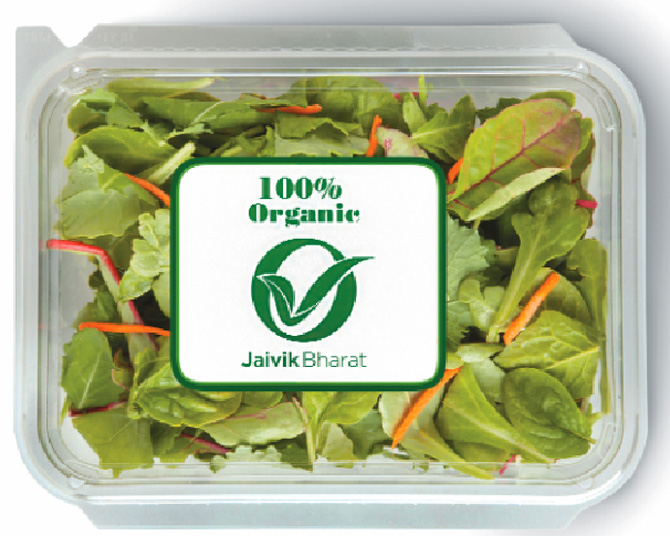
On a retail shelf, the practical shortcut is this: look for the FSSAI logo and licence number first — that’s non-negotiable on any packaged food. Then check for Jaivik Bharat alongside either the India Organic or PGS-India Organic mark underneath it. All three together is the strongest possible signal of genuine, verifiable organic certification.
The 2025 Shift: Enter the Unified India Organic Logo
This comparison has recently gotten a further update. In 2024, FSSAI and APEDA jointly announced a new Unified India Organic logo, designed specifically to reduce the exact confusion this article is addressing — two separate green logos on the same shelf. The stated intent was to bring the domestic FSSAI framework and the export-oriented NPOP framework into one consistent visual identity, rather than requiring brands to juggle both marks separately.
Following a formal notification and a transition window for certification bodies, the Unified India Organic logo has been progressively replacing the older India Organic (NPOP) mark on newly certified stock through 2025. For products intended for the domestic Indian market, industry advisories have indicated that the Jaivik Bharat logo continues to be required alongside the certification mark — so the practical shopping advice hasn’t changed even as the visual branding evolves. If you see an unfamiliar new green logo alongside Jaivik Bharat instead of the older India Organic emblem, that’s very likely this transition in progress, not a red flag.
Because certification-body transitions of this kind roll out gradually across a large market, you may see the older India Organic mark, the newer Unified logo, or both in circulation for some time yet. Either way, the core rule for shoppers stays the same: never trust the word “organic” alone — look for the certification mark backed by an FSSAI licence number.
Which One Should You Actually Trust?
If you’re a household shopper in India, Jaivik Bharat is the mark to look for on your kitchen shelf — it’s the one FSSAI requires specifically for domestic retail sale, and its presence confirms the product’s underlying NPOP or PGS-India certification has been checked against India’s food-safety framework. Seeing India Organic (or the newer Unified logo) alongside it is a bonus confirmation, not a substitute.
If you’re a producer, exporter, or B2B buyer, the calculation flips slightly: India Organic (NPOP) certification is what international buyers and importing countries recognise, since NPOP standards have equivalence arrangements with several overseas markets. You’ll still need Jaivik Bharat recognition on top of that if any portion of the same product line is sold within India.
For a full walkthrough of what’s actually covered under Jaivik Bharat-eligible certification — from fresh produce to processed foods to organic cotton — see our companion guide on Jaivik Bharat certified products: what to buy and where. And if you’re building a broader organic living routine around genuinely certified organic food, understanding this logo layering is one of the simplest ways to shop with real confidence rather than falling for greenwashed labels.
Frequently Asked Questions
Jaivik Bharat is a recognition logo issued by FSSAI, not a certification body in itself. A product can only carry it if it is already certified under NPOP (India Organic) or PGS-India — Jaivik Bharat confirms that underlying certification meets India’s domestic food-safety framework.
Yes, and it commonly does. A product certified under NPOP is entitled to the India Organic logo, and once it is also sold domestically with FSSAI recognition, it can carry the Jaivik Bharat logo alongside it. Seeing both together is a strong, not contradictory, signal of genuine certification.
For domestic consumers, Jaivik Bharat is the more relevant mark to check, since FSSAI requires it specifically for organic food sold in Indian retail. India Organic (NPOP) matters more to exporters and international buyers, though it remains a valid additional confirmation for shoppers too.
The Unified India Organic logo is a newer mark jointly developed by FSSAI and APEDA to bring the domestic and export-oriented certification frameworks under one consistent visual identity. It is progressively replacing the older India Organic (NPOP) logo, but it does not eliminate the need for the Jaivik Bharat logo on products sold domestically — the two continue to work together during this transition.
Not necessarily fake, but worth double-checking. It may be older packaging predating full Jaivik Bharat compliance, export-focused stock, or a product still in transition. When in doubt, verify the certifying body and licence number through the Indian Organic Integrity Database before buying.