
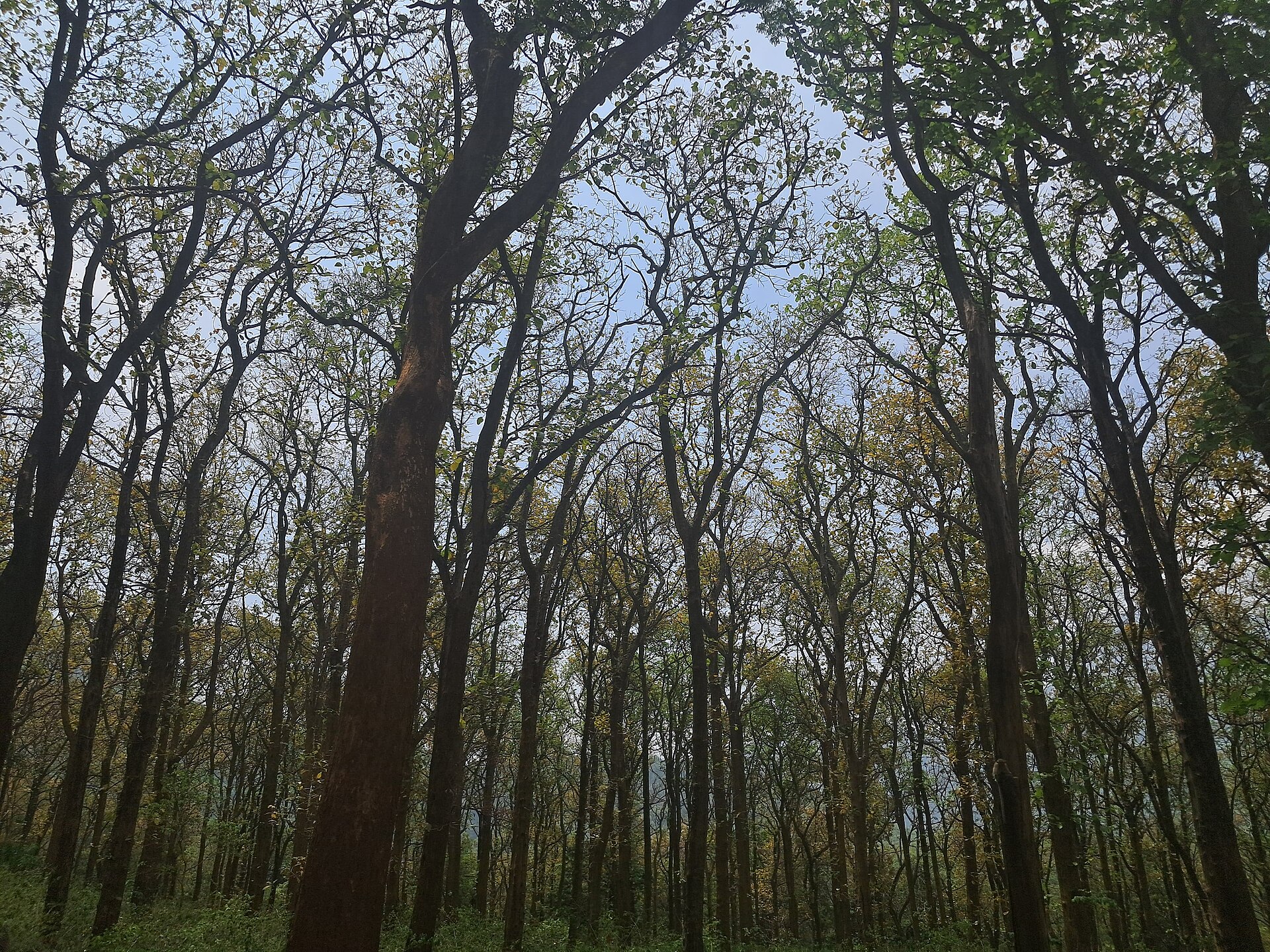
Under the still water and mud of a wetland in Madhya Pradesh lies a diary. Each layer of sediment has trapped pollen from the trees and crops that grew nearby, and by reading the Bandhavgarh pollen record scientists at the Birbal Sahni Institute of Palaeosciences (BSIP) in Lucknow have reconstructed about 2,700 years of monsoon history in one of India’s best-known tiger reserves. The punchline is hopeful: when the rains returned, the forest did too.
The Bandhavgarh pollen study
BSIP, an autonomous institute under the Department of Science and Technology, worked on a sediment core taken from the Chakradhara wetland in Bandhavgarh Tiger Reserve, Umaria district. Researchers Dr Anjali Trivedi, Anupam Nag and Prof. M. G. Thakkar dated the core with radiocarbon, counted the pollen in each segment, and matched the results against an Earth System Palaeoclimate Simulation (ESPS) model to check the reconstruction. The work was published in the journal Quaternary Research.
The site matters because it sits in India’s Core Monsoon Zone, the central belt where rainfall and farming are tightly linked. The institute notes that high-resolution records for this zone over the late Holocene were scarce.
What the sediment recorded
- About 2,700 to 2,300 years ago: A strong monsoon supported dense, moist deciduous forest dominated by sal (Shorea robusta). Sal at that scale points to roughly 1,100-1,200 mm of rain a year or more, with a timely onset.
- About 2,300 to 1,600 years ago: A rollercoaster, with humid spells, prolonged drought, gradual recovery and then a stronger monsoon, reshaping the forest’s mix and layout.
- About 1,600 to 820 years ago: Relatively stable monsoon and dense tropical forest.
- About 820 to 400 years ago: A weaker monsoon. Moist forest shrank, dry deciduous vegetation spread, and pollen of cereals and other crops rose, a sign of more farming and land-use change.
- The last roughly 400 years: A strengthening monsoon, and recovery and expansion of moist deciduous forest.
(All dates are “years before present”, as is standard in palaeoscience. The paper’s authors also tie the shifts to events in Indian history, which the PIB summary mentions but does not detail.)
Why this matters outside a lab
Indian agriculture still leans heavily on monsoon rainfall, so even small changes in timing or intensity can ripple into crop yields, food security and the economy. Short weather records cannot show how wide natural swings can be. A 2,700-year record can: it shows the monsoon in central India has gone through long dry and wet phases well before any modern warming, which helps separate natural variability from what is being added now. (Prakati recently covered a similar archive from the Ganga plain: 4,600 years of monsoon history in Karela Lake.)
The second lesson is about forests. The record shows tropical forest can regenerate when conditions turn favourable, and that humans have been shaping this landscape for centuries. That is encouraging news for restoration work, such as the projects discussed in our report on India at the UN forestry body COFO 28. It is not a licence for complacency. Regeneration in the record took centuries and happened under a strengthening monsoon, whereas today’s pressures include fragmentation, heat and unpredictable rain arriving at once.
The study’s authors say the findings can help climate adaptation strategies, sustainable agriculture and future climate resilience. In practice that means giving forest managers, planners and farmers a longer baseline of what rainfall patterns the region’s ecosystems have actually lived through.
The takeaway
A tiger reserve is also an archive. Protecting places like Bandhavgarh preserves tigers and sal forests, and also the wetland sediments that tell us how climate has behaved before. The paper is available through Quaternary Research (DOI 10.1017/qua.2026.10093).