
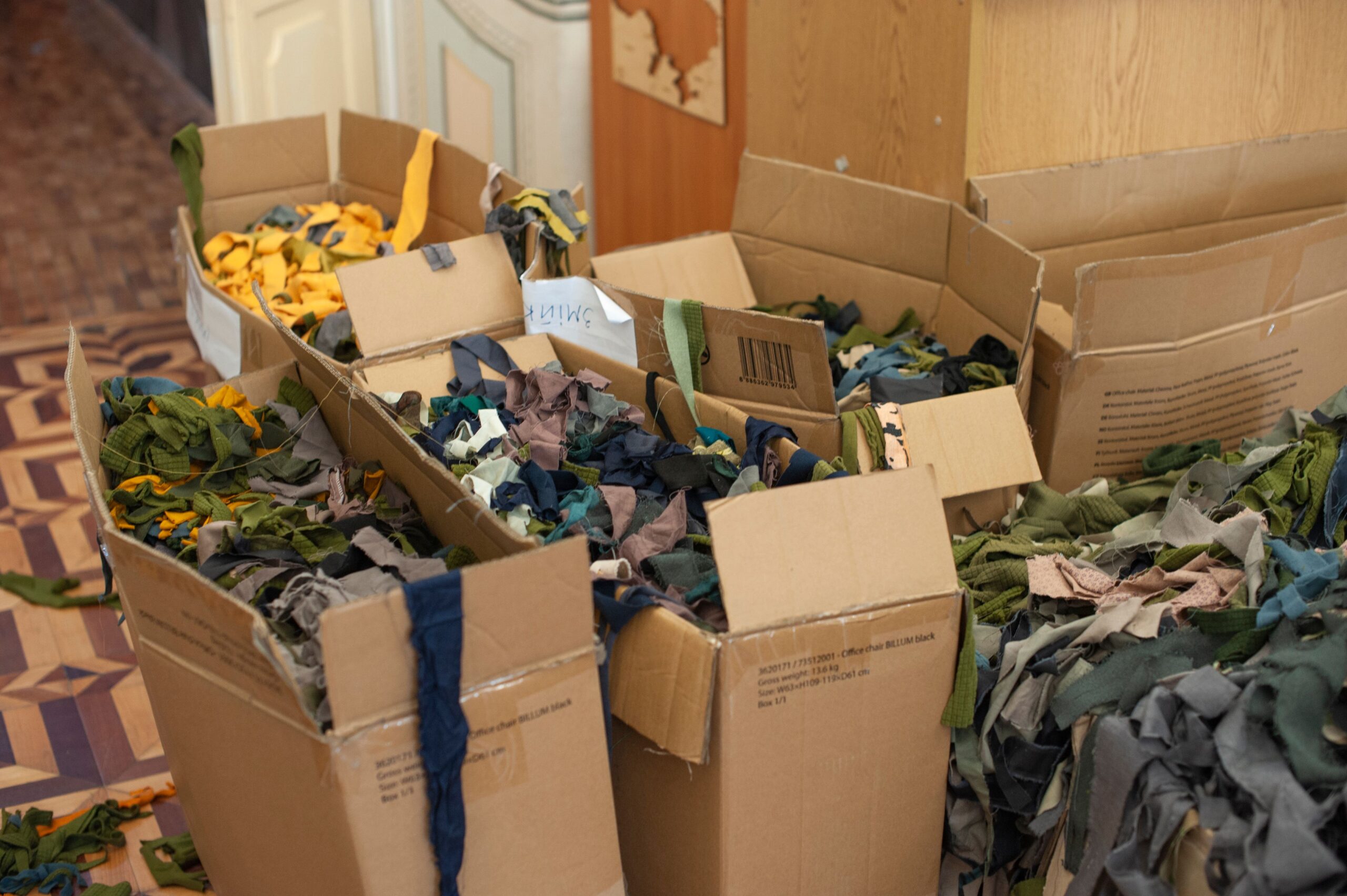
Somewhere in Mongolpuri, Delhi, roadside handlers at Katran Market sort through cutting waste trucked in from garment units in Noida, Gurugram, Manesar and Jaipur — separating it by colour so it can be sold on to bigger recycling clusters. A few hundred kilometres away, in Panipat, that sorted waste gets pulled apart, respun and rewoven into new yarn and fabric at industrial scale. Neither place shows up in most conversations about “sustainable fashion.” Together, they’re part of why India already recycles more than 70% of the roughly 7.8 million tonnes of textile waste it generates and handles every year — a recovery rate most developed economies would envy.
That figure comes from a new government backgrounder that, for the first time, tries to map India’s textile circularity end to end: from cotton field to cutting-room floor to the informal waste picker’s sorting table. It’s a useful corrective to the usual sustainable-fashion narrative, which tends to focus on eco-friendly brands and organic labels. The bigger, less visible story is this vast, largely informal recovery economy that already exists — and that policy is only now catching up to.
According to the backgrounder, over 90% of India’s managed textile waste is domestic — pre-consumer factory scrap and post-consumer waste, rather than imported second-hand clothing. Recovery is strongest at the pre-consumer stage, where nearly 95% of factory-floor waste is collected and reused through established value chains — largely because it’s cleaner, more uniform, and easier to sort than waste that’s already been worn, washed and discarded by consumers. The spinning sector is held up as a near-perfect closed loop: almost all spinning waste gets reintegrated straight back into production. Post-consumer textiles fare worse but still respectably — about 55% is diverted from landfill through India’s collection and sorting networks, most of it powered by an estimated 40–45 lakh livelihoods, disproportionately women from marginalised communities doing the collecting, sorting and redistributing.
The numbers behind the 70%
Three specific hubs illustrate how this actually works on the ground. Navi Mumbai’s Belapur facility — described as India’s first Municipal Textile Recovery Facility — has processed over 41,000 items and developed more than 400 upcycled product samples since launch, reaching 1.14 lakh families and supporting women artisans through exhibitions and market linkages. Panipat has become the country’s dominant downstream recycling hub, handling an estimated 3,500 to 5,250 tonnes of waste per day. And Mongolpuri’s informal Katran Market — arguably the least glamorous link in the chain — moves over 10 tonnes of sorted cutting waste daily into the formal recycling system.
Why the government is paying attention now
Textiles are not a marginal industry for India — the sector contributes roughly 2% of GDP and 11% of manufacturing gross value added, employs more than 45 million people, and makes India the world’s sixth-largest textile and apparel exporter, per National Account Statistics 2025 cited in the backgrounder. As buyers in the EU, UK and US move toward extended producer responsibility rules and mandatory recycled-content requirements for apparel, circularity is shifting from a nice-to-have to a market-access requirement. Independent industry estimates put India’s textile recycling market at roughly $3.5 billion by 2030 if current momentum holds — a meaningful economic upside layered on top of the environmental case.
The policy response spans the entire value chain rather than a single flagship scheme. On the input side, the National Programme for Organic Production certifies organic cotton to standards recognised by the European Commission and Switzerland; the Jute-ICARE programme, running since 2015, has expanded sustainable jute cultivation from 130 blocks in 7 states to 289 blocks across 10, nearly doubling area coverage to 2.15 lakh hectares by 2024–25; and a New Age Fibre Mission is trying to build viable domestic supply chains for natural alternatives to synthetic fibre, like ramie, sisal and flax.
The gap between recovery and value
What the backgrounder doesn’t dwell on, but the numbers imply, is where the opportunity — and the risk — actually sits. A 70% recovery rate sounds like a circular economy success story, and in tonnage terms it is. But much of that recovered material is currently downcycled into lower-value products (wiping cloths, insulation, stuffing) rather than being spun back into new, wearable fabric — genuine fibre-to-fibre, “textile-to-textile” recycling, the kind that actually closes the loop and displaces virgin cotton or polyester production, remains a minority of the total. The backgrounder’s own framing of Panipat as having “strong scope for higher-value textile-to-textile recycling through improved material separation” is a tacit admission that the technology and sorting infrastructure to do this at scale is still being built out.
There’s also a livelihoods question buried in the data. The 40–45 lakh people who currently sustain this recovery economy do so largely outside formal labour protections — as informal collectors, sorters and small processors. As India formalises and scales this sector to meet export-market circularity requirements, how those livelihoods get protected, upgraded or displaced will matter as much as the recycling percentages themselves. For a country whose textile circularity is currently powered more by economic necessity and informal ingenuity than by high-tech recycling plants, that’s the real test of whether “sustainable textiles” ends up meaning something for the workers at the bottom of the waste-recovery chain, not just the brands at the top of it.
Source: Press Information Bureau, Government of India — PRID 2283837