
India’s solar expansion has always run into the same quiet constraint: land. Ground-mounted solar parks need tens of thousands of contiguous acres, and in a country where agricultural land is scarce and contested, that has meant delays, resistance, and difficult trade-offs between food and energy security. On July 31, the Union Cabinet approved a scheme that sidesteps the problem entirely — by putting the panels on water instead.
The Pradhan Mantri Surya Sarovar Yojana (PM-SSY), cleared with a total outlay of Rs. 5,070 crore, will support the development of 5,000 MW of Floating Solar Photovoltaic (FSPV) projects paired with Energy Storage Systems, to be sanctioned between FY 2026-27 and FY 2030-31, with financial disbursement continuing through FY 2032-33. It is, on paper, a straightforward capacity-addition scheme. In practice, it is India’s first serious attempt to convert a long-known but largely untapped resource — its reservoirs — into a mainstream part of the renewable energy mix.
A 102 GW resource that barely gets used
The scale of the opportunity is the real story here. According to a nationwide assessment by the National Institute of Solar Energy (NISE), India’s reservoirs and other suitable inland water bodies can support approximately 102.18 GWp of floating solar capacity — a figure derived from mapping over 11,000 waterbodies and identifying roughly 682 of them, covering about 1,946 square kilometres, as technically feasible for floating panels. Today, the country has installed barely 700 MW of floating solar. PM-SSY aims to grow that figure more than eightfold, to 5,700 MW, in one policy stroke — and it still would only scratch the surface of the assessed potential.
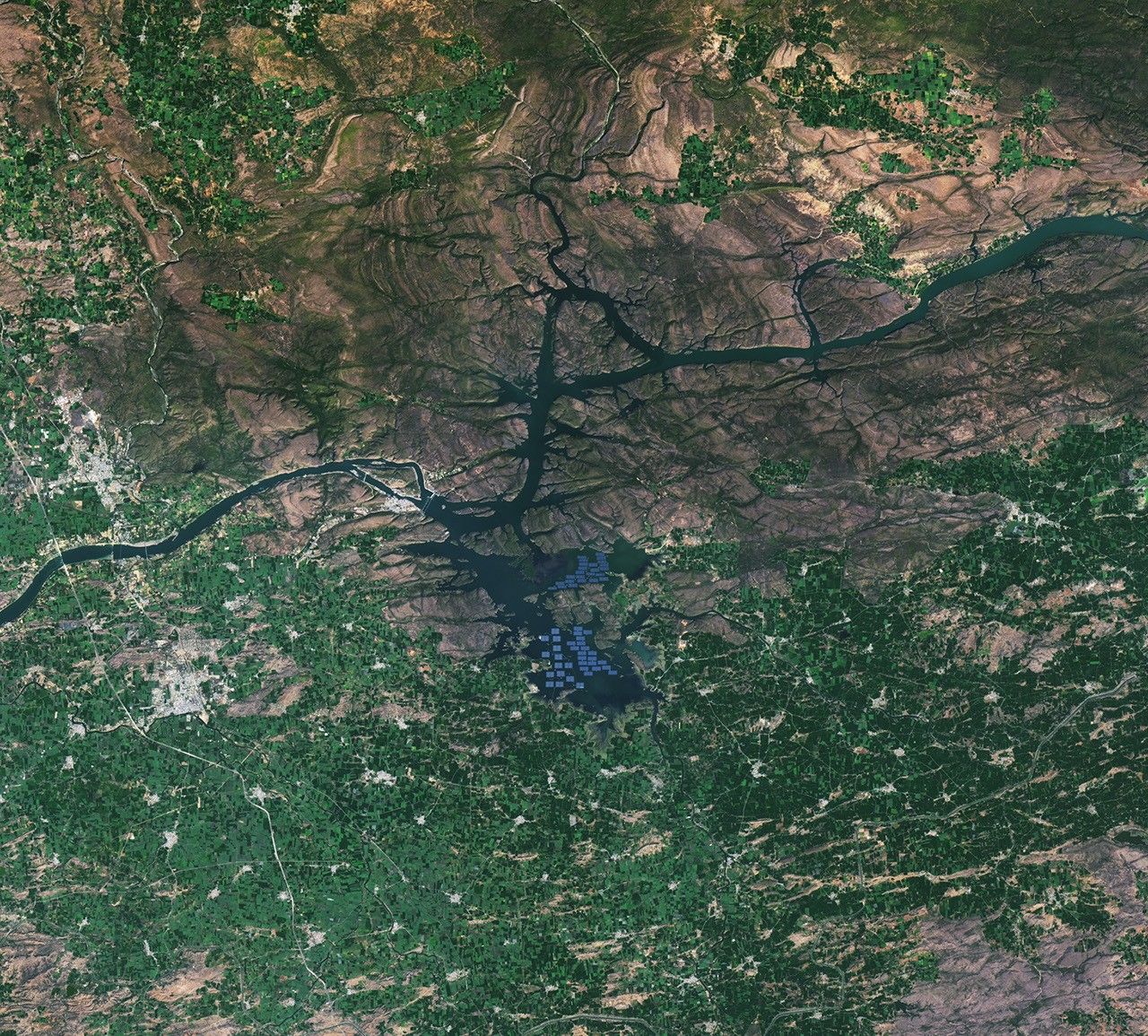
According to a nationwide assessment by the National Institute of Solar Energy (NISE), India’s reservoirs and other suitable inland water bodies can support approximately 102.18 GWp of floating solar capacity, based on mapping over 11,000 waterbodies nationwide.
Why water, not land
The advantage of floating solar isn’t just that it avoids competing with farmland or forest for space — though that matters enormously in a country where land acquisition disputes have stalled solar and wind projects for years. It’s that water and solar panels turn out to help each other. Panels floating on a reservoir surface are naturally cooled by the water beneath them, which measurably improves their electricity-generation efficiency compared to the same panels baking on dry ground. In return, the panels shade the water, cutting evaporation losses from reservoirs by an estimated 30 to 60 percent in studies of similar installations — a meaningful co-benefit for a country where water stress is a recurring seasonal crisis in exactly the regions with the strongest sun.
The scheme also folds in energy storage as a mandatory, co-located component — a minimum of two hours’ storage duration, working out to 10,000 MWh at full scale — rather than treating batteries as a bolt-on for later. That detail matters more than it might look: solar-only capacity additions have increasingly run into a familiar problem in India’s grid, where midday solar generation floods the system and then vanishes at dusk exactly when demand peaks. Storage attached at the point of generation is one of the more direct ways to blunt that mismatch, and building it into the scheme’s design from day one — rather than adding it as a later retrofit — is a meaningfully different approach from how India built out its first wave of solar capacity a decade ago.
What the money actually buys
Under PM-SSY, developers will receive Central Financial Assistance of Rs. 1 crore per MW after a project is successfully commissioned, plus up to Rs. 50 lakh per project to fund the feasibility studies — bathymetry surveys, hydrography assessments, environmental studies — that floating solar requires but ground-mounted solar largely doesn’t. That upfront support for feasibility work is a deliberate answer to one of floating solar’s practical bottlenecks: developers have historically had to absorb the cost of these specialised surveys themselves, which made floating projects harder to underwrite than a conventional solar park on flat, surveyed land.
The government’s own estimates attached to the scheme put the annual emissions reduction at around 10 million tonnes of CO₂, alongside 16,000 to 17,000 full-time-equivalent jobs across the project value chain — spanning floatation-system fabrication, PV cell and module manufacturing, and storage system assembly, all of which the scheme explicitly positions as opportunities for domestic manufacturing rather than imported equipment.
The land India didn’t have to give up
What makes PM-SSY worth paying attention to isn’t the megawatt number by itself — India adds gigawatts of solar capacity most years now. It’s the resource base it draws on. Every megawatt of floating solar is a megawatt that didn’t require clearing land, relocating a village, or converting agricultural fields. For a country whose renewable energy ambitions have often run headlong into its land-use constraints, a scheme built specifically around the water it already has — indeed, water infrastructure it has spent decades building and maintaining — is a different kind of climate math altogether.
Source: Press Information Bureau, Government of India — “Cabinet approves Pradhan Mantri Surya Sarovar Yojana (PM-SSY) for Development of Floating Solar Photovoltaic Projects with Energy Storage Systems with a total outlay of Rs.5,070 crore”, Ministry of New and Renewable Energy / Cabinet, 31 July 2026.