
Prakati Products · Natural Paints
Khadi Prakritik Paint
India’s first cow dung paint: what is in the tub, who makes it, and what to check before you buy.
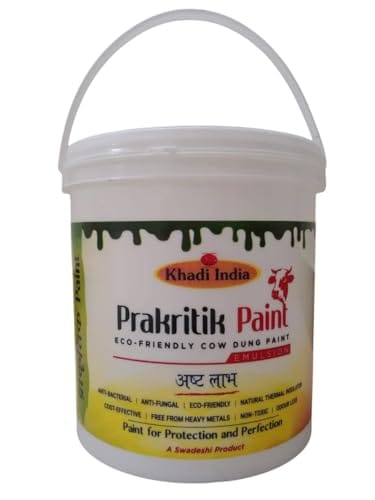
On 12 January 2021, Union Minister Nitin Gadkari launched Khadi Prakritik Paint, a wall paint with cow dung as its main ingredient, developed by the Khadi and Village Industries Commission (KVIC). The idea is simple: turn a farm by-product into something every household buys. This page gathers what is publicly known about the paint, drawn from the official launch release and the makers’ association, and says plainly which claims you should verify yourself. Our original news report on the launch is still online.

At a glance
- Developed by
- Khadi and Village Industries Commission (KVIC), through the Kumarappa National Handmade Paper Institute, Jaipur
- Conceived
- March 2020, by the KVIC Chairman
- Launched
- 12 January 2021
- Main ingredient
- Cow dung
- Forms
- Distemper and plastic emulsion
- Base colour
- White, with other shades made by mixing colorants
- Where it can be used
- Interior and exterior walls
- Drying time
- Less than 4 hours
- Standards reported
- Emulsion: BIS 15489:2013. Distemper: BIS 428:2013
- Launch prices
- ₹120 per litre (distemper) and ₹225 per litre (emulsion)
Source: Press Information Bureau release of 12 January 2021. Launch prices are from that release and will not match today’s shelf prices.
Why paint with cow dung
Dung is plentiful, cheap and already part of village economies. KVIC says using it as a raw material will bring additional revenue to farmers and gaushalas, and that putting it to use keeps it out of drains, where it can cause clogging. The launch release also describes the paint as anti-fungal, anti-bacterial and odourless, and free from heavy metals such as lead, mercury, chromium, arsenic and cadmium.
The Prakritik Paint Manufacturers Association (PPMA) adds that the paint is washable, waterproof and a natural thermal insulator. Those points are the association’s own claims and are not part of the official release.
Distemper or emulsion
The paint comes in two forms. In general, distemper is the traditional low-cost wall finish, while plastic emulsion gives a smoother, more durable surface. KVIC reports a different BIS standard for each.
Distemper
- BIS standard reported
- IS 428:2013
- Launch price
- ₹120 per litre
- Range name (PPMA)
- Prakritik Paint Distemper
Plastic emulsion
- BIS standard reported
- IS 15489:2013
- Launch price
- ₹225 per litre
- Range names (PPMA)
- Sampoorn (interior and exterior), Shobha (interior only)
If you plan to paint an outside wall, read the label of the exact product: one emulsion in the PPMA range is listed as interior only.
Who makes it
KVIC developed the formulation, and its release describes technology transfer to local manufacturers, so the paint reaches buyers under several makers’ labels. The PPMA says it works in collaboration with KVIC, brings manufacturers from several states together and reports production of about 5.2 lakh litres a month. Each maker’s tub is its own product, so judge it by its own label and paperwork.
Before you buy
- Find the maker’s name. “Khadi Prakritik” is a product name, and marketplace pages often list the brand as just “Generic”. The manufacturer is usually named further down the page or on the tub.
- Ask for that maker’s test report. The BIS references in the launch release describe the KVIC formulation. They are not a certificate for every tub on sale.
- Check the form and the use. Distemper or emulsion, interior or exterior, and the shade you need.
- Compare the price per litre. Pack sizes and sellers differ, and so does the price for the same litre of paint.
- Test a patch. Clean the wall, repair cracks, fix any damp first, then paint a small area and let it dry fully before ordering more.
Where to buy online
Two Amazon.in listings sold under the Khadi Prakritik name, each from a different maker. Both are emulsions, and we have not tested either paint.
Disclosure: these are Amazon India affiliate links. If you buy through them, Prakati may earn a small commission at no extra cost to you, which helps keep our sustainability journalism free.
Mithila Gau Paints Emulsion, 1 L
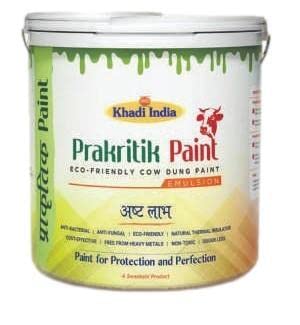
Shri Krishna Khadi Works Emulsion, 4 L
Frequently asked questions
Is Khadi Prakritik Paint really made from cow dung?
Yes. The KVIC launch release names cow dung as its main ingredient. The other components are not itemised publicly, so ask a maker for its full formulation sheet.
Is Khadi Prakritik Paint BIS certified?
The release says the paint has been certified by the Bureau of Indian Standards, citing BIS 15489:2013 for the emulsion and BIS 428:2013 for the distemper. It was tested at National Test House in Mumbai and Ghaziabad and at Shri Ram Institute for Industrial Research in New Delhi. Those results describe the KVIC formulation, so ask each maker for its own report.
Can it be used on exterior walls?
The release says the paint can be applied on interior and exterior walls. The PPMA range lists one emulsion, Shobha, as interior only, so check the label of the exact product.
How long does it take to dry?
Less than four hours, according to the launch release, with a smooth and uniform finish.
How much does it cost?
At launch, the distemper was priced at ₹120 per litre and the emulsion at ₹225 per litre. Prices today depend on the maker, the pack size and the seller, so compare the price per litre before you buy.
A wall coat with a village behind it
Browse more eco-friendly products on Prakati, read our sustainable product guides, and follow how KVIC backs rural industries. Looking for green builders and suppliers? Explore the Prakati Green Directory.