
The Coconut Map of India
From the sacred shores of Kerala to the craft workshops of Tamil Nadu — a coffee-table journey through the fruit that feeds, heals, shelters, and inspires a nation.
Kalpavriksha — The Wish-Fulfilling Tree
Long before coconut was a global superfood trend, it was enshrined in Sanskrit literature as Kalpavriksha — a compound of kalpa (wish, aeon) and vriksha (tree). Hindu mythology places this tree among the divine gifts to emerge from the Samudra Manthan, the churning of the cosmic ocean. To possess a coconut tree, ancient texts suggested, was to possess a provider of perpetual abundance.The name is no hyperbole. A single mature coconut palm yields nearly every material a household needs: food, drink, oil for the skin and lamp, fibre for rope and mat, shell for utensils and charcoal, timber for construction, and fronds for thatch. In coastal Karnataka and Kerala, the palm is said to have a thousand uses — thengina mara in Kannada, thengu in Tamil, thengine in Malayalam. Each region has its own intimate vocabulary for a tree it has cohabitated with for millennia.The botanical name Cocos nucifera derives from the Portuguese and Spanish coco — meaning a grinning face — a reference to the three dark pores at the base of the nut that resemble two eyes and a mouth. But long before Portuguese navigators arrived on India’s western coast, the coconut had already been cultivated here for thousands of years, carried by traders across the Indian Ocean along routes that made it truly cosmopolitan.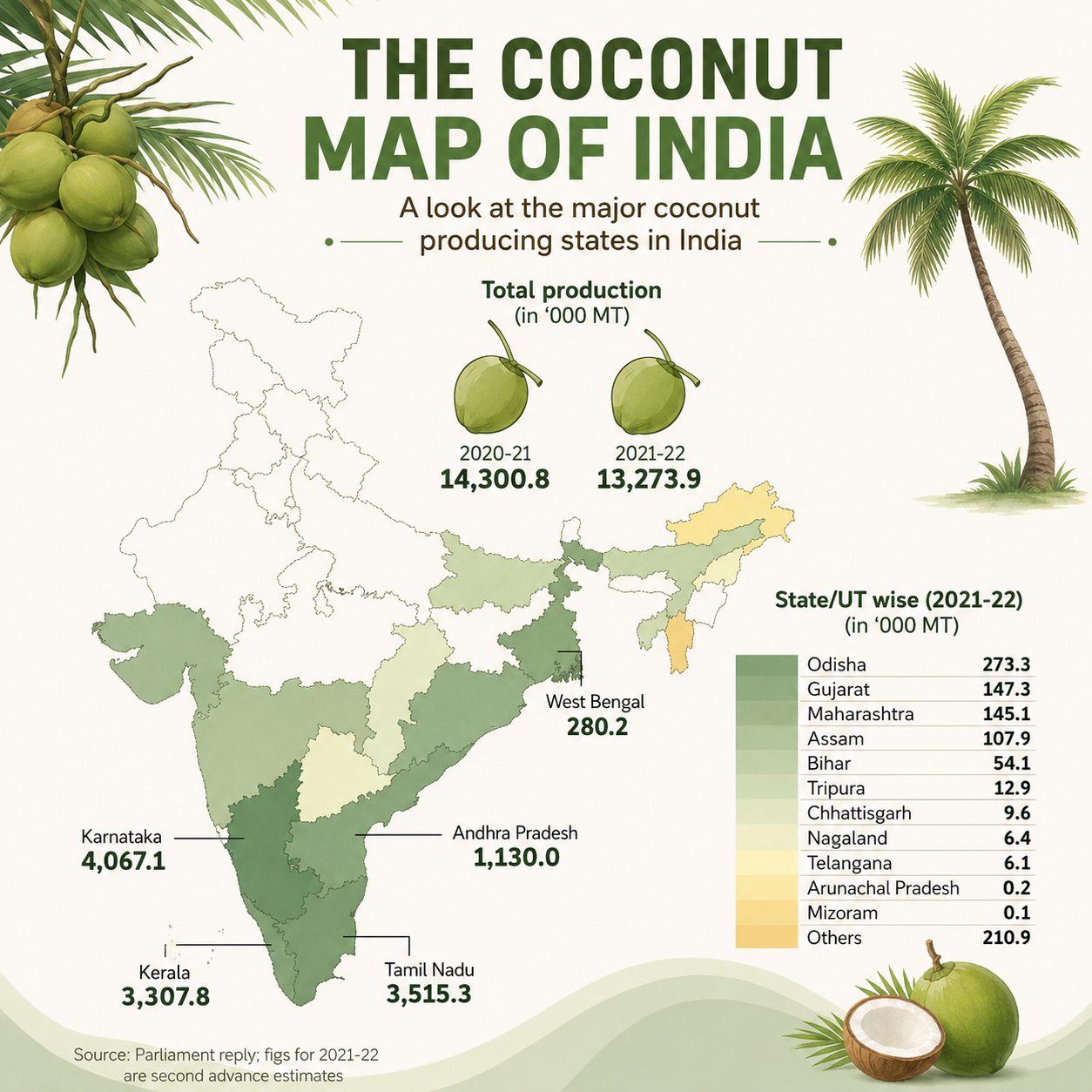
“The coconut tree is the tree of life itself. From root to crown, not a single part is wasted. It lives, it gives, and when it falls, it gives once more.”
Traditional saying from Kerala’s coastal communitiesA Taxonomy of the Coconut
Not all coconuts are the same. India’s diverse agro-climatic zones host a rich spectrum of varieties — tall, dwarf, and hybrid — each with distinct characteristics suited to different soils, seasons, and purposes.By Maturity: The Three Stages of the Nut
A single coconut fruit journeys through distinct stages, each prized for a different set of qualities:- Tender (Green) Coconut — 6 to 8 months: The husk is smooth and bright green or yellow. The water inside is at its sweetest and most electrolyte-rich. The flesh (malai) is soft and jelly-like — scooped out and eaten directly, or blended into smoothies and desserts.
- Semi-mature — 9 to 10 months: The water volume begins to reduce as the flesh thickens. The meat is firmer but still tender enough to grate. Used extensively in Kerala and Tamil Nadu cooking.
- Mature (Brown) Coconut — 11 to 13 months: The husk has turned brown and fibrous. The water is reduced, but the flesh is dense, rich in oil, and deeply flavoured. This is the coconut of copra, of coconut oil, of grated coconut in chutneys and curries.
Tall, Dwarf & Hybrid: India’s Major Varieties
West Coast Tall (WCT)
Tall Variety • Pan-IndiaThe most widely cultivated variety in India, particularly across Kerala, Karnataka, and Tamil Nadu. It is long-lived (80–100 years), drought-tolerant, and produces large nuts with high copra content. Grows to 20–30 metres. The backbone of India’s coconut economy.East Coast Tall (ECT)
Tall Variety • Andhra & OdishaThe dominant variety along India’s eastern coastline. Adapted to the slightly different rainfall patterns of Andhra Pradesh and Odisha. It is more tolerant of salinity, making it ideal for the coastal Godavari delta region. Produces nuts with good water content.Chowghat Orange Dwarf (COD)
Dwarf Variety • KeralaFirst identified in the Chavakkad area of Thrissur, Kerala. Known locally as Chenthengu or Gowrigathram. Its distinctly orange-yellow fruits make it immediately recognisable. Bears fruit in just 3–4 years (versus 6–7 for talls). Yields 60–65 nuts per year.Kalpa Raksha (VPM1/VPM2)
CPCRI Hybrid • High-YieldA high-performing hybrid developed by the Central Plantation Crops Research Institute (CPCRI) in Kasaragod, Kerala — crossing West Coast Tall with Orange Dwarf. Begins bearing in 3–4 years, grows to a manageable 6–7 metres, and yields significantly more nuts per tree per year.Gangabondam Green Dwarf (GBGD)
Dwarf Variety • Andhra PradeshA popular green dwarf variety from Andhra Pradesh, known for its very high water content at the tender stage. Widely used in the fresh coconut water trade. Its compact size makes it well-suited to home gardens and small holdings.Kalpa Sree
CPCRI Hybrid • High CopraAnother CPCRI-developed hybrid, Kalpa Sree is bred specifically for high copra yield — making it the preferred choice for coconut oil production. It combines early-bearing tendencies of dwarfs with the nut size of tall varieties.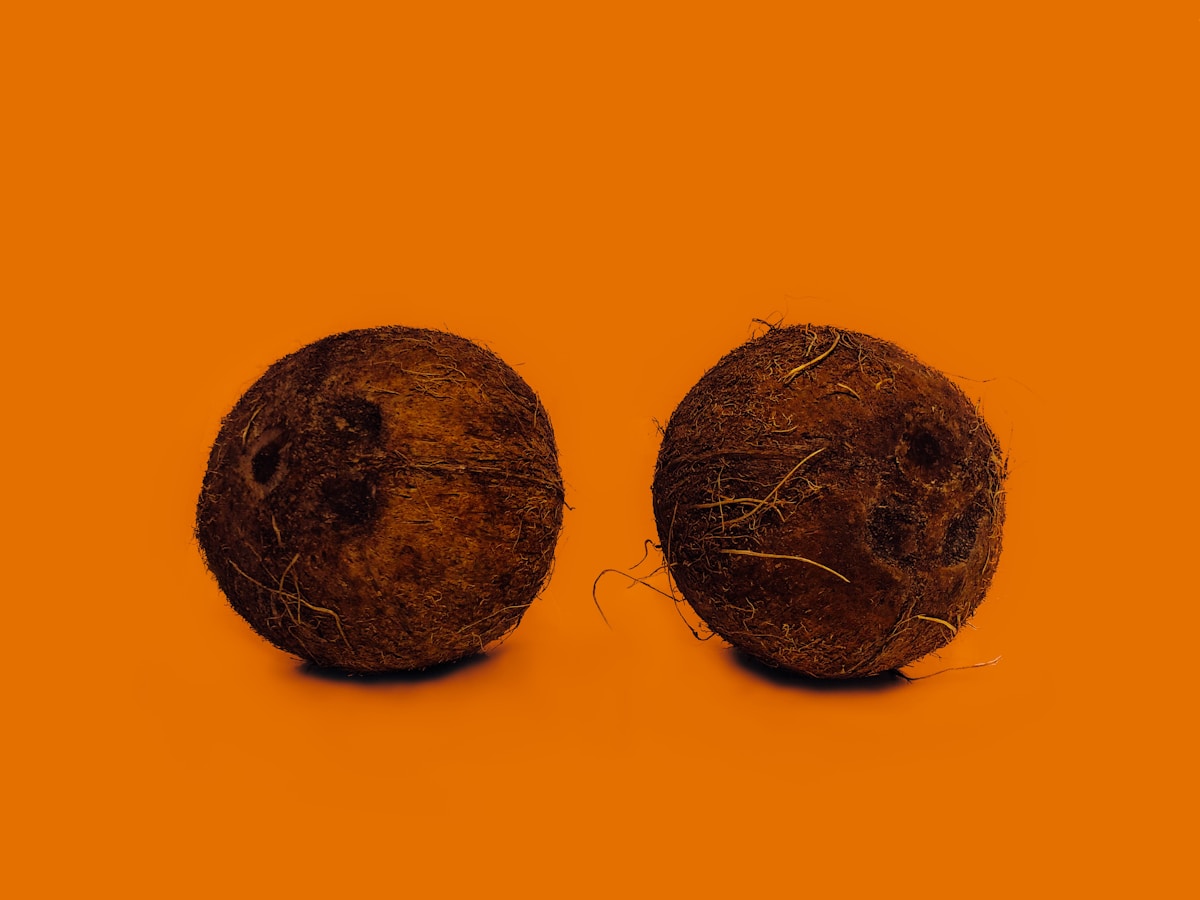
Mature Coconut — The Copra Nut
Harvested at 11 to 13 months, the mature brown coconut is the foundation of coconut oil, copra, and grated coconut used in South Indian cooking. The water is reduced, but the flesh is dense, richly flavoured, and oil-laden — the workhorse of the Indian kitchen and the coir industry alike.
The Coconut Map of India
India is the world’s third-largest coconut producer, after Indonesia and the Philippines, accounting for roughly 28% of global output. Any coconut map of India will show that within the country, the distribution is anything but uniform. The coconut belt clings tightly to the coastlines and river deltas of peninsular India — a crescent of green from Goa down to Kanyakumari and back up the eastern coast.State-wise Production — 2021-22 (in ‘000 Metric Tonnes)
Source: Parliament reply; figures for 2021-22 are second advance estimates. As reported in News18 / Coconut Board of India.
Why the Concentration?
Coconut is a tropical crop with narrow climate preferences: it thrives between latitudes 20°N and 20°S, requires a mean annual temperature of 27°C, and needs consistently high humidity — ideally 80% or more. India’s peninsular coastlines offer precisely this combination, supplemented by the monsoon. The Malabar Coast (Kerala) and the Coromandel Coast (Tamil Nadu and Andhra) are the two historical epicentres of coconut civilisation in India.Karnataka’s rise to the top of the production table is more recent — driven by large-scale farm mechanisation, irrigation-supported inland cultivation in districts like Tumkur, Mandya, Dakshina Kannada, and Udupi, and the state’s proximity to Bangalore’s growing coconut-product processing industry.Meanwhile, West Bengal and Odisha’s entries on the list reflect the crop’s expansion along the eastern seaboard, where salinity-tolerant East Coast Tall varieties are now cultivated in coastal districts. Even landlocked Assam and Bihar produce modest quantities in their riverine plains.
Why the Coconut Belt is Where It Is
Coconut thrives between latitudes 20°N and 20°S, at mean temperatures around 27°C and humidity above 80%. India’s peninsular coastlines — the Malabar and Coromandel Coasts — are the historical epicentres. Karnataka, Tamil Nadu, and Kerala together account for over 82% of national output.
When India Harvests Its Coconuts
Unlike many seasonal crops, the coconut palm produces fruit year-round. A mature, well-maintained tree can be harvested 6 to 10 times a year. However, supply peaks and troughs are real — shaped by regional rainfall, irrigation access, and the physiology of the palm itself.The Annual Harvest Rhythm
The two principal harvest windows are February to May and September to December. Kerala’s principal post-monsoon crop peaks between October and December. Tamil Nadu and Karnataka, where irrigation is more reliable, sustain both windows consistently. The lean months of June through August correspond with heavy south-west monsoon rains in Kerala, when harvesting climbers cannot safely work the tall palms.
Nuts for tender coconut water are harvested around the 6th to 8th month after pollination — the ideal window for maximum water content and the characteristic jelly-soft malai. Nuts for copra and oil are left to fully mature for 11 to 12 months. This staggered harvesting is one reason coconut supply does not collapse in any single month.The Art of the Coconut Climber
Harvesting a tall coconut palm is a centuries-old skill. Traditional climbers (thattan in Malayalam) scale palms up to 25 metres in seconds using a looped rope around their ankles. In recent years, Karnataka and Tamil Nadu have seen a sharp decline in trained climbers — triggering demand for mechanical harvesting solutions, including rope-and-pulley systems and, more recently, experimental drone-based harvesting being piloted in Coimbatore and Pollachi.Sacred, Auspicious, Indispensable
Few foods in India carry the symbolic weight of the coconut. It is the only fruit used to represent God in Hindu religious practice. The three marks at the base of the nut are said to represent the three eyes of Lord Shiva — or alternately, the Tridev: Brahma the creator, Vishnu the preserver, and Shiva the destroyer.The Breaking of the Coconut
Smashing a coconut at the feet of a deity is one of Hinduism’s most universally practised rituals — found from the Himalayas to Kanyakumari, from Gujarat to Assam. Historians trace its formalisation to the 8th-century philosopher Adi Shankaracharya, who replaced the practice of animal sacrifice (narbali) with the coconut as a symbolic substitute. The breaking of the coconut represents the shattering of the ego — the hard outer shell of pride — to reveal the pure white flesh within: the self, surrendered to the divine.In practice, coconuts are broken at the commencement of every significant undertaking: the foundation of a building, the launch of a ship, the beginning of a business, the start of a journey, the purchase of a vehicle. The louder the crack, the better the omen.Festival by Festival
- Onam (Kerala): The grandest harvest festival of Kerala is inseparable from the coconut. The Onam Sadhya — a vegetarian feast served on banana leaves — features at least 26 dishes, the majority of which use coconut: avial (mixed vegetables in coconut and yoghurt), thoran (dry coconut stir-fry), erissery (pumpkin in coconut sauce), payasam (coconut milk pudding). The pookalam (floral rangoli) itself is often decorated with coconut-husk motifs.
- Pongal (Tamil Nadu): The harvest thanksgiving festival opens with the boiling of the first rice in sugarcane juice, a ritual where coconuts are gifted among households and offered to the sun deity Surya. Kobbari mithai — coconut sweet — is inseparable from the celebration.
- Ganesh Chaturthi: Fresh coconut is offered to Lord Ganesha across Maharashtra, Karnataka, and Tamil Nadu. Modak, the deity’s favourite sweet, is traditionally made with fresh grated coconut and jaggery enclosed in a rice-flour shell.
- Nariyal Purnima: Celebrated along India’s western coast, this festival marks the end of the monsoon and the reopening of the sea to fishing. Fishermen offer coconuts to the ocean as a prayer for a safe and abundant season.
- Diwali: Coconuts form part of Lakshmi puja offerings in many households across India, symbolising prosperity and fullness.

The Coconut and Onam
The grandest harvest festival of Kerala is inseparable from the coconut. The Onam Sadhya — a vegetarian feast served on banana leaves — features at least 26 dishes, the majority of which use coconut: avial, thoran, erissery, and payasam. The coconut palm itself, reflected in Kerala’s backwaters and temple ponds, is the living emblem of this celebration.
The Breaking of the Coconut
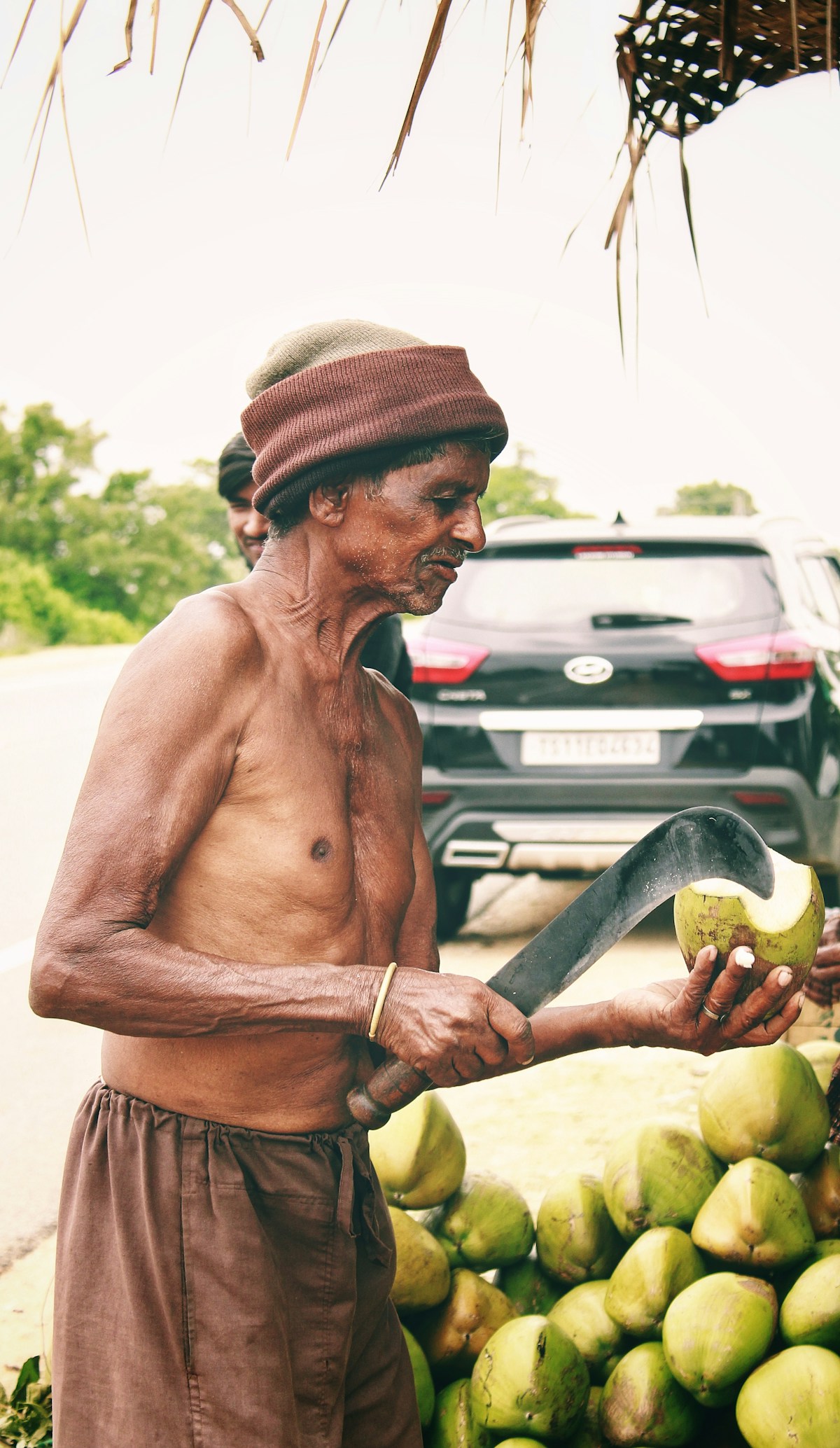
From the vendor’s stall to the temple sanctum, the coconut is broken open at the start of every significant undertaking — a business launch, a journey, a puja. The loud crack of the shell is a good omen. The three dark pores at the base are likened to the three eyes of Shiva. In India, the coconut is not merely a fruit. It is a ritual.
The Language of the Coconut
India’s regional languages carry the coconut’s cultural weight in their very vocabulary. In Sanskrit, it is narikela — giving the Hindi nariyal. In Malayalam, thenga (the nut) and thenga maram (the tree). In Tamil, thengai or kobbari. In Kannada, thengina kayi. In Marathi, naral. In Telugu, kobbari kaya. The proliferation of distinct words, distinct idioms, and distinct proverbs around the coconut reflects how deeply it has shaped each culture’s domestic imagination.What Science Says About the Coconut
The coconut has had a complicated relationship with modern nutrition science — beloved in traditional medicine, vilified during the low-fat era of the 1980s and 90s, and now rehabilitated by research into its distinctive fatty acid profile. Here is what we actually know:Coconut Water
Nature’s electrolyte drink. Rich in potassium, sodium, magnesium, and calcium. ~95% water with lower sugar than most fruit juices. Research in PMC (2025) confirms cardio-protective amino acid L-arginine. Ideal post-exercise hydration.Coconut Flesh (Copra)
High in dietary fibre, manganese, copper, and selenium. Unlike most fruits, coconut is fat-dominant — but those fats are largely medium-chain triglycerides (MCTs), which the liver metabolises rapidly for energy rather than storing as fat.Coconut Oil
~50% lauric acid — a rare medium-chain fatty acid with documented antimicrobial properties. Research (2009) found lauric acid inhibits acne-causing P. acnes at concentrations 15x lower than benzoyl peroxide. Use in moderation due to saturated fat content.Coconut Milk
A complete dairy alternative, free from lactose, soy, nuts, and grains. Rich in MCTs that support neurological health. An excellent cooking medium in curries, soups, and desserts — delivering creaminess without dairy’s inflammatory proteins.The Soft Malai
The jelly-like flesh of a tender coconut is 90% water and extremely gentle on the digestive system. Traditionally prescribed in Ayurveda as a post-illness recovery food and for pregnant women. Naturally cooling, easily digestible, mildly sweet.Ayurvedic Context
In Ayurveda, coconut is classified as guru (heavy) and snigdha (unctuous) — grounding for Vata dosha. Coconut oil is a base for many taila (medicated oil) preparations. Traditionally used for hair, skin, and scalp treatments across Kerala’s classical medicine traditions.From Coast to Table — Coconut in Indian Cuisine
The coconut’s journey through the Indian kitchen is one of the most sophisticated and regionally diverse in any culinary tradition. It is not merely an ingredient — it is a technique, a texture, a philosophy of cooking that divides India’s culinary map more clearly than almost any other element.South India: The Coconut Belt of Cuisine
Cross the Vindhyas heading south, and coconut becomes as fundamental to cooking as onion and tomato are in the north. Every form of the nut finds its place:- Grated fresh coconut — the base of every chutney (blended with green chilli, ginger, and tempered with curry leaves), thoran, and kootu from Kerala to Tamil Nadu to Andhra.
- Roasted grated coconut — dry-roasted and ground for Chettinad gravies, Kerala fish curry masala, and Karnataka’s bisi bele bath.
- Coconut milk (thick and thin) — the defining liquid of Kerala’s stew (vegetable or chicken, with appam), payasam, and mappas. The first press (thick milk) goes in last, never boiled, to preserve its delicate sweetness. The second press (thin milk) simmers with the main ingredients.
- Coconut oil — the default cooking fat of Kerala. Its distinctive flavour defines the identity of a dish as unmistakably Keralite. Debates about its health profile notwithstanding, it remains the only fat that gives puttu, kadala curry, and a proper Kerala breakfast their character.
- Copra (dried coconut) — smoke-dried coconut chunks used in Andhra Pradesh and Telangana curries, Goan xacuti, and Karnataka’s ennegai (stuffed brinjal).
- Coconut jaggery (toddy palm jaggery) — from the sap of the coconut flower, a deeply caramelised natural sweetener used in payasam, nei appam, and kozhukattai.
West India: Goa and the Konkan Coast
Goan cuisine cannot exist without coconut. The iconic Goan fish curry — bright orange, tangy with kokum, and thick with coconut — is practically a cultural statement. The Konkan coast, stretching through coastal Maharashtra to Mangalore, uses fresh grated coconut in sol kadhi (the cooling pink digestif drink), malvani curry, and dozens of coastal fish preparations.East India: An Emerging Coconut Culture
Bengal uses coconut in its sweets — narkel naru (coconut ladoo with jaggery) is a Durga Puja essential. Odisha’s coastal cuisine incorporates coconut in dalma (lentil-vegetable dish) and in sweets like kheer sagara. Assamese cooking uses fresh coconut in til pitha and coconut rice preparations during Bihu.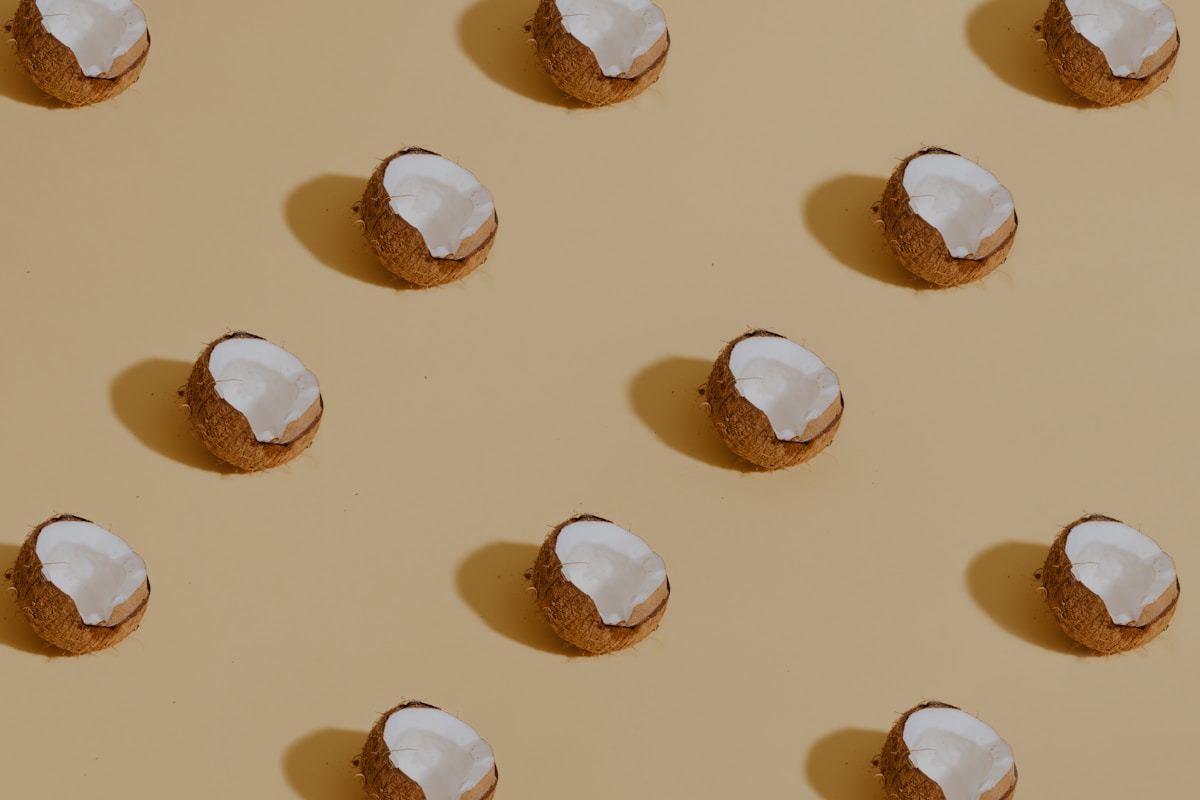
Fresh Coconut — The Base of South Indian Cooking
Grated fresh coconut is the foundation of every South Indian chutney, thoran, and kootu. The first press of thick coconut milk defines Kerala stews and payasam. The second press simmers in the main gravy. Whether raw, roasted, or pressed, no ingredient divides India’s culinary map as clearly as the coconut.
A Tree That Gives Everything
The coconut’s genius lies in its total usability. From the outermost husk to the innermost shell, each layer of the fruit is a distinct material with industrial or artisan applications. In India’s coastal communities, throwing away any part of the coconut would once have been considered not just wasteful, but unthinkable.Coir — The Fibre of the Husk
The fibrous mesocarp between the outer green skin and the hard shell is coir — one of India’s most valuable agro-industrial exports. India produces approximately 518,000 tonnes of coir annually, accounting for nearly half of global supply. Kerala alone employs over 500,000 people — predominantly women — in coir processing. Traditional uses include ropes, mats, brushes, and mattresses. Modern applications extend to geotextiles for soil erosion control, biodegradable packaging, car seat cushioning, and bio-composite construction materials.Coco Peat — The Shell’s Soil
The fine, brown dust that falls off during coir extraction is coco peat — a growing medium used in horticulture and hydroponics worldwide. It retains water up to ten times its weight, is pH-neutral, and biodegradable. India exports coco peat bricks and blocks to Europe, the Middle East, and Australia as a sustainable alternative to peat moss, which is extracted from fragile bog ecosystems.Coconut Shell — The Artisan’s Medium
The hard inner shell of the coconut is one of the densest natural materials in any plant kingdom — harder than most hardwoods. Artisans in Kerala, Tamil Nadu, and Karnataka have worked coconut shells for nearly 900 years, producing bowls, cups, spoons, ladles, jewellery, decorative boxes, and musical instruments. The Vishwakarma community of Kerala is particularly known for its intricate brass-inlaid coconut shell work. Industrially, coconut shell is carbonised to produce activated carbon — used in water purifiers, air filters, and gold recovery processes.Coconut Fronds — Thatch and Broom
The long palm fronds are woven into thattu (thatched roof sections) for temporary shelters and beach shacks. Stripped fronds become the chavatti — the traditional palm broom found in every South Indian home. Young leaflets are woven into baskets, kudams (temple decorations), and the elaborate kolam motifs used in festivals. In Tamil Nadu, entire wedding pandals are still built from woven coconut fronds.Toddy — The Sap of the Flower
Tapping the coconut’s flower spadix yields a sweet, slightly fermented sap called toddy (kallu in Kerala, neera when fresh). Fresh neera is consumed as a nutritious drink rich in B vitamins and minerals. Fermented, it becomes the traditional toddy of Kerala’s kallu shaap (toddy shops) — a mild alcoholic drink central to working-class coastal culture. Distilled further, it becomes coconut feni — Goa’s famous spirit. The dried sap becomes coconut jaggery, used across South India as a natural sweetener.Coconut Wood — The Timber of the Poor
At the end of a palm’s productive life (typically 80–100 years for tall varieties), the trunk itself becomes a building material known as coco-wood or porcupine wood — named for its distinctive speckled cross-section. In Kerala and coastal Karnataka, older homes feature coco-wood beams, flooring, and furniture. It is now increasingly valued as a sustainable alternative to rainforest hardwoods, being denser and more termite-resistant than most plantation timbers.
A Tree with a Thousand Uses
From the outermost husk to the innermost shell, the coconut palm wastes nothing. Fronds are woven into thatch, brooms, and temple decorations. The shell becomes charcoal and activated carbon. Coir from the husk employs over 500,000 people in Kerala alone. Coco-wood from aged trunks is denser than most plantation timbers.
New Life for an Ancient Fruit
The global health and sustainability movements of the past two decades have triggered a remarkable renaissance in coconut product innovation. India, as the world’s third-largest producer with the deepest cultural relationship with the palm, is at the centre of this wave — both as a raw material supplier and as an incubator of new ideas.Malai — Coconut Water Leather
A Kerala-born startup by Susmith Suseelan and Zuzana Gombosova, Malai Biomaterials collects coconut water waste from processing units across South India and ferments it into bacterial cellulose — a flexible, water-resistant, home-compostable biomaterial that looks and feels like leather. It breaks down within 90–150 days, contains no synthetic chemicals, and has been adopted by fashion designers in India and Europe. Monthly production capacity: 200 square metres. PETA-approved. It is, perhaps, the most elegant example of zero-waste innovation from a single crop.Coconut in Modern Skincare
Lauric acid — coconut oil’s dominant fatty acid — has found its way into a new generation of Indian skincare formulations. Brands like Mamaearth (Honey Malai Face Wash, Coco Soft body range) use coconut oil and malai as key actives. Research confirms lauric acid’s efficacy against acne-causing bacteria at concentrations far lower than synthetic alternatives. Coconut hair oil remains India’s single largest hair care category — Parachute alone sells over 100 million bottles annually.Coconut Sugar, Flour & Aminos
The global market for alternative coconut food products is expanding rapidly. Coconut sugar (from dried toddy sap) has a lower glycaemic index than refined cane sugar and retains trace minerals. Coconut flour — a gluten-free byproduct of coconut oil extraction — is a high-fibre, high-protein baking alternative growing at 6.5% CAGR globally. Coconut aminos (from sap) are a soy-free, lower-sodium alternative to soy sauce, now stocked in health food stores across Indian metros.Shell Bowls & Coir Packaging
A wave of eco-conscious startups and artisan collectives — including Kerala-based Sunbird Straws (coconut-leaf straws) and Greenaura — are building sustainable product lines from parts of the coconut that were previously discarded. Coconut shells are becoming premium serving bowls in restaurants, coir is replacing synthetic foam in packaging, and coconut husk is being pressed into biodegradable material boards. The broader coconut products market is projected to reach USD 22.2 billion by 2032.Coconut Shell in Water Purification
Coconut shell-derived activated carbon is now one of the most effective and sustainable filtration media for water and air purification systems globally. India’s coconut-abundant south is home to a growing activated carbon processing industry — with export markets in Japan, South Korea, and the EU for food-grade and pharmaceutical-grade activated carbon made from coconut shells that would otherwise be burned or discarded.Drone Harvesting & Smart Farming
With trained coconut climbers in sharp decline — an ageing profession with few young entrants — Tamil Nadu’s Coimbatore and Pollachi regions are piloting robotic and drone-assisted harvesting systems. The state government’s Coconut Development Board has supported mechanised harvesting trials, and startups are developing rope-guided climbing robots that can harvest a palm in under five minutes, addressing one of the sector’s most persistent labour bottlenecks.The Most Sustainable Crop You Already Know
No coconut map of India would be complete without acknowledging what the palm represents ecologically. By almost every metric, the coconut is one of the most sustainable agricultural crops on earth. Its environmental footprint is remarkably light:- Perennial & long-lived: A single palm produces for 60–80 productive years without replanting. This dramatically reduces the soil disruption, water use, and carbon cost associated with annual crops.
- No synthetic inputs needed: Coconut is typically grown without pesticides or herbicides. Organic certification is easy and widespread — one reason coconut products command organic premiums in export markets.
- Zero waste by design: As this article has documented, every part of the coconut — water, flesh, oil, husk, shell, frond, timber, sap — has productive uses. Very few crops in the world approach this level of whole-plant utilisation.
- Carbon sequestration: Coconut palms are effective carbon sinks. Their long lifespan and year-round leaf area make them net carbon absorbers over their productive life.
- Biodiversity support: Coconut groves support a diverse understory ecosystem — many coastal Karnataka and Kerala farms practice multi-layer agroforestry under coconut canopy, growing arecanut, black pepper, banana, and tapioca simultaneously.
- Livelihood & women’s employment: The coir industry employs over 500,000 people, of whom the majority are women in coastal rural households. Coconut is one of the few major crops in India where women are the primary processing workforce.
“In a world searching for sustainable alternatives, India holds one of the most powerful answers in something it has always had — the coconut palm. It is ancient technology that happens to be perfectly modern.”
Prakati EditorialThe Fruit That Carries a Civilisation
The coconut is not just India’s most versatile crop — it is a mirror of the subcontinent’s values: nothing wasted, everything honoured, the ordinary elevated to the sacred. From the tender green nut cracked open on a roadside to the elaborately woven coir mat, from the laboratory-grade activated carbon filter to the bacteria-fermented leather of Malai Studio, the coconut continues to write new chapters of an ancient story.In a country where agriculture has too often become a story of depletion, the coconut palm stands apart: a perennial giver that asks very little in return. Knowing its geography, its varieties, its seasons, and its uses is not just useful knowledge — it is a form of respect for one of India’s most enduring relationships with the natural world.Explore more on Sustainable Farming, Organic Living, and Sustainable Living at Prakati.Sources & Image Credits
- Coconut Board of India — Annual Production Statistics 2021-22
- Parliament Reply, Government of India — Coconut Production Data
- News18 Creative — The Coconut Map of India (infographic)
- CPCRI (Central Plantation Crops Research Institute), Kasaragod
- TNAU Agritech Portal — Coconut Varieties & Harvesting
- PMC / NCBI — Research Progress in Coconut Water (2025)
- The Better India — Malai Biomaterials & Coconut Startups
- YourStory — Malai: Crafting Leather from Coconut Water (2023)
- Parachute Kalpavriksha — Tall & Dwarf Coconut Varieties
- Springer Nature / Journal of Ethnic Foods — Coconut in Indian Rituals (2022)
- Coconut Export India — Seasonal Supply Trends
- BioResources, NCSU — Coir Applications Beyond Traditional Uses
- Cleveland Clinic / Healthline — Coconut Nutrition & Health
- Mordor Intelligence — Coconut Products Market Forecast 2025-2031
- All article images: Unsplash.com (free to use under Unsplash licence)