
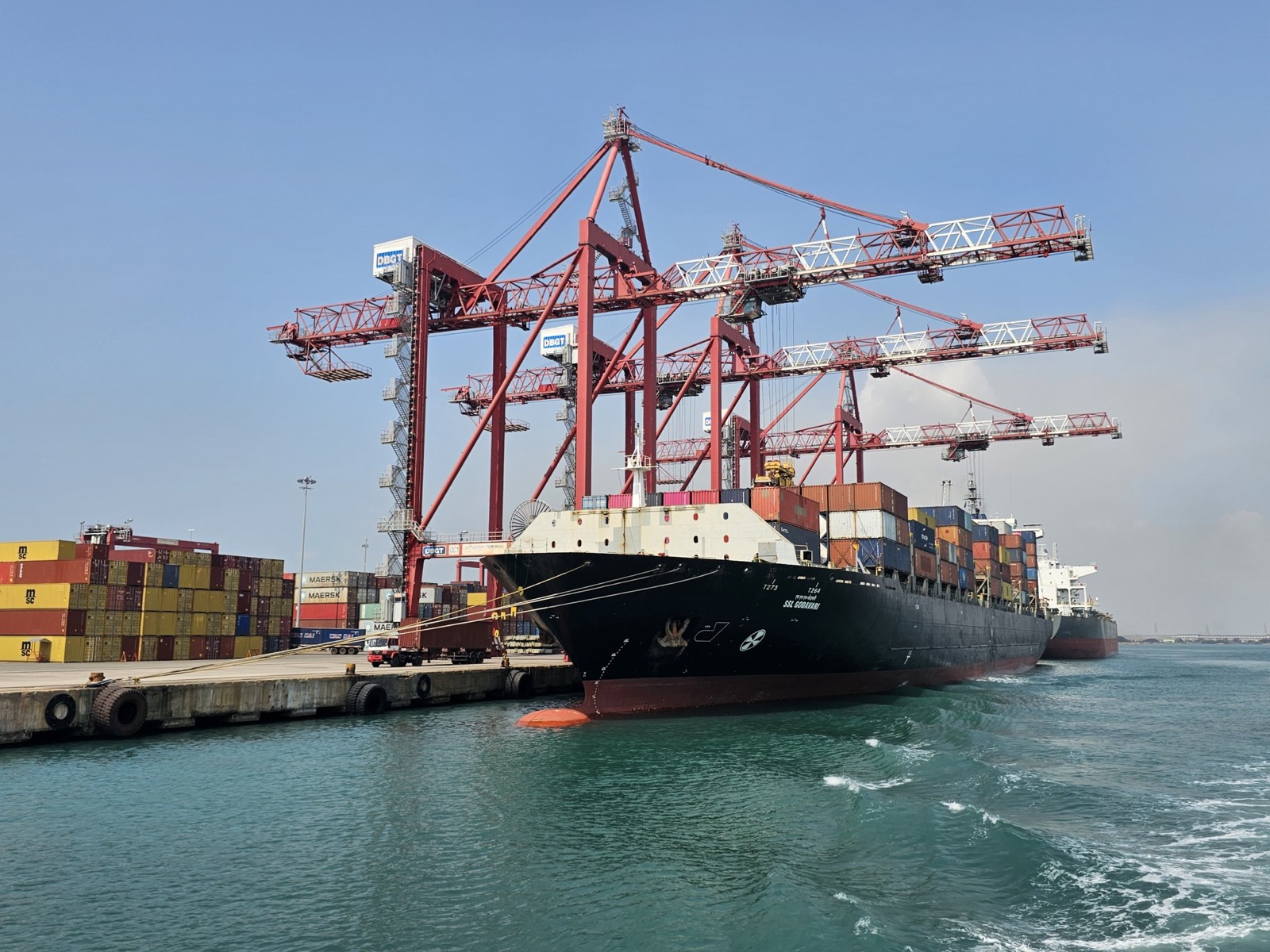
Most conversations about India’s clean energy transition centre on solar farms and EV charging stations. But one of the country’s most striking sustainability turnarounds is happening somewhere far less glamorous: a cargo port on the Tamil Nadu coast.
V.O. Chidambaranar Port (VOC Port) in Tuticorin has just published its first-ever Sustainability Report, and the numbers are hard to ignore. Net carbon emissions are down by roughly 45% over the past four years. Renewable energy now offsets nearly 94% of the port’s total energy consumption. And carbon intensity per tonne of cargo handled — a key efficiency metric for ports — has been cut almost in half over the same period.
For a working port that loads and unloads ships every day, that’s not a small shift. It’s a sign that decarbonisation isn’t only viable in showcase renewable energy projects — it can be retrofitted into the gritty, high-throughput infrastructure that keeps trade moving.
Why a port, and why now
Ports are energy-intensive by nature: cranes, conveyor systems, lighting, cold storage, and constant vehicle movement all draw heavily on grid power, traditionally from fossil-fuel sources. They’re also natural bottlenecks in global supply chains, which makes their environmental footprint outsized relative to their physical size.
That’s part of why the Ministry of Ports, Shipping and Waterways named VOC Port — along with Deendayal Port in Gujarat and Paradip Port in Odisha — as one of India’s official Green Hydrogen Hubs under the National Green Hydrogen Mission. The Mission’s broader ambition is steep: at least 5 million tonnes of green hydrogen production capacity by 2030, alongside roughly 125 GW of new renewable capacity, with an estimated 50 million tonnes of CO2 emissions averted annually once at scale.
VOC Port has leaned into that mandate. It now hosts India’s first green hydrogen pilot project at a major port — a detail substantial enough that IIM Calcutta turned it into a case study, “The Hydrogen Pivot: Orchestrating the Green Transition at V.O. Chidambaranar Port Authority,” tracing the port’s shift from a conventional cargo hub to what officials are calling a green energy and sustainable maritime centre.
The port has also been recognised as a “Scope-2 Emission Free Port” — meaning the electricity it draws from the grid is now effectively decarbonised through its renewable energy investments. That’s a meaningful certification in a sector where Scope 2 emissions (purchased electricity) are often the easiest decarbonisation lever and the hardest to actually pull.
Beyond the carbon numbers
The announcement, made by Union Minister Sarbananda Sonowal, wasn’t only about emissions. VOC Port Authority has signed an MoU with Gati Shakti Vishwavidyalaya in Vadodara to build a Centre of Excellence in Maritime Logistics and Port Management — pairing the port’s sustainability push with research and skill-building rather than treating it as a one-off compliance exercise. A new Kendriya Vidyalaya on the port campus, meanwhile, extends quality education access to the children of port workers and the surrounding Tuticorin community, a reminder that sustainable infrastructure projects often carry social dividends alongside environmental ones.
The bigger picture
India’s ports collectively handle the overwhelming majority of the country’s trade by volume, which means their energy choices ripple outward into virtually every other sector. If VOC Port’s renewable-energy-to-94%-of-consumption ratio can be replicated at India’s other major ports — several of which are also working toward net-zero and green hydrogen capability — the cumulative emissions reduction could be substantial well before 2030.
It’s a useful reminder that sustainability transitions don’t only happen through new technology launches and policy headlines. Sometimes they happen quietly, port by port, as old infrastructure is rebuilt around cleaner sustainable transport energy — and the results, when measured honestly and published, end up making a genuinely compelling case for going green.
Source: Press Information Bureau, Government of India (PRID 2277098)