
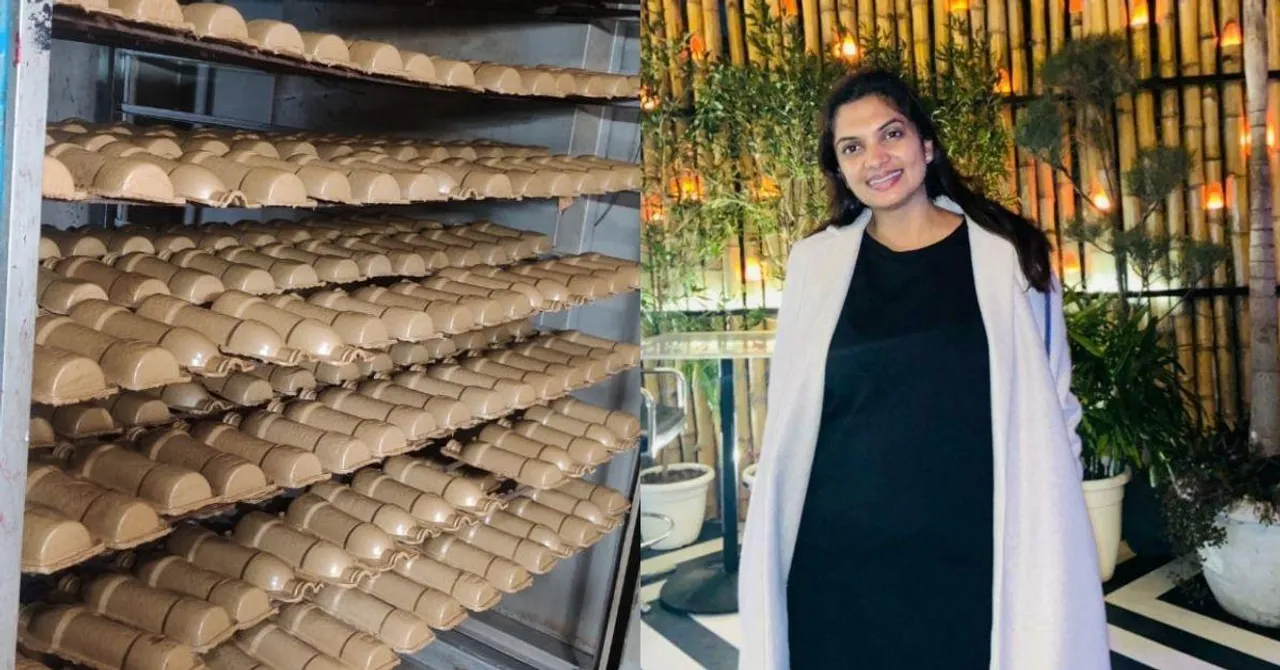
In a country generating over 3.5 million tonnes of plastic waste every year, Samiksha Ganeriwal is doing something quietly radical: making bottles out of paper. As the founder of Kagzi Bottles, a Noida-based startup, she has built India’s first 100% compostable paper bottle — a genuine alternative to the single-use plastic containers that clog India’s drains, rivers, and landfills. What makes it even more compelling is that her bottles are cheaper than the plastic ones they replace.
Who is Samiksha Ganeriwal?
Samiksha Ganeriwal grew up with a quiet awareness of environmental issues, an awareness that found its first form in a college project on replacing plastic bags. She went on to complete her MBA and spent years working with multinational companies in Hyderabad and Noida, building practical expertise in business operations. In 2016, she established a packaging solutions company — and it was while consulting on an eco-friendly packaging project for a client in 2018 that her path crystallised. She made a decision that would reshape the next several years of her life: she would create a bottle made entirely of paper.
Two years of development, prototyping, and problem-solving followed. Samiksha had to source custom-built machinery, because no off-the-shelf equipment existed for what she was trying to make. She invested Rs 12 lakhs to get the venture off the ground, working through early obstacles with patience and precision. In December 2020, Kagzi Bottles officially launched its prototype — a brown, paper-textured bottle containing no plastic and certified 100% compostable. The name “Kagzi” comes from kaagaz, the Hindi word for paper — rooting the brand firmly in its identity and its origins.
The Problem: India’s Plastic Crisis
India’s relationship with plastic packaging is enormous in scale and deeply entrenched. The average Indian uses around seven plastic bottles every month for toiletries alone — shampoo, conditioner, lotion, body wash. Multiply that by 1.4 billion people, and the numbers become staggering. Unlike PET bottles collected in some recycling streams, the small HDPE and PP bottles used for personal care products rarely get recycled. They end up in landfills, waterways, and eventually the ocean.
India’s plastic pollution challenge is one of the most urgent waste management problems the country faces. The government has moved to ban several single-use plastics, but packaging — especially for personal care and FMCG products — remains a massive unresolved problem. Solving it requires innovation at the material level, not just regulation at the policy level. That is precisely what Kagzi Bottles is working on.
Kagzi Bottles: Paper Bottles That Biodegrade
The manufacturing process behind Kagzi Bottles is elegant in its simplicity. Waste paper, sourced from a supplier in Baddi, Himachal Pradesh, is mixed with water and chemicals to create a pulp. That pulp is moulded into the two halves of a bottle shape, then assembled with adhesive. The challenge — making a paper container hold liquid without leaking — is solved with a spray solution that mimics the natural water-resistant properties of a banana leaf. Samiksha has spoken about how she looked to nature for this answer: grass, bark, leaves, the lotus — all naturally waterproof without a layer of plastic. The spray creates that same barrier, entirely compostable.
The result is a bottle that looks and feels different from what consumers are used to: solid brown, opaque, textured like paper. Samiksha acknowledges that early customers were sometimes surprised by the appearance — “They were quite surprised with the shape and colour as it is completely brown and people are so used to plastic bottles.” But the material integrity holds. The bottles are designed for shampoos, conditioners, and lotions, and the company is working to expand into food, beverages, liquids, and powders.
What sets Kagzi Bottles apart from global attempts at paper packaging by companies like Coca-Cola or L’Oréal is completeness: those global bottles still use a thin inner plastic lining to handle moisture. Kagzi’s does not. It is, as far as verified, India’s first genuinely plastic-free, 100% compostable bottle. The company’s manufacturing unit is currently operational and producing approximately 2 lakh bottles per month. Kagzi Bottles is also listed on the Prakati Green Directory, recognising it as a verified sustainable business.
Affordable Sustainability
One of the most persistent myths about sustainable products is that they must cost more. Kagzi Bottles challenges this directly. Each bottle is priced between Rs 19 and Rs 22 — cheaper than comparable plastic alternatives, not a premium over them. This matters enormously for scale. In India, price sensitivity is a fundamental driver of consumer choice across income segments. A sustainable packaging solution that costs more than plastic will always struggle for mainstream adoption. One that costs less changes the entire equation.
For FMCG brands and personal care companies looking to make credible commitments on sustainable living, Kagzi Bottles offers something rare: a drop-in alternative that does not require them to raise prices for the end consumer. This makes the business case for adoption far stronger than most green packaging innovations manage to achieve.
Impact and Vision
Samiksha’s vision extends well beyond Noida. The company is working toward setting up manufacturing units across four Indian cities, a move that would significantly increase capacity and reduce logistics costs for customers across the country. The product roadmap includes packaging for food products, beverages, and powders — categories that together represent a far larger share of plastic packaging consumption than personal care alone.
At its core, what Samiksha Ganeriwal has built is a proof of concept for something the sustainability world needs more of: a genuinely better material that wins on price, not just on ethics. For India’s sustainability changemakers, she represents a generation of entrepreneurs who are not waiting for policy to lead — they are building the solutions themselves. As Samiksha herself puts it: “We need to get conscious about what we are doing to the environment.” With Kagzi Bottles, she is making it easier — and cheaper — for everyone to do exactly that.
Hi mam
My name is ansh patel. I’m from Gujarat.last few months I finding your content.please give me your appointment.me and my friend meet you about paper bottles.